
You've probably heard about high contrast flashcards for newborns—but do they really work? The truth is surprising: black and white images aren't just about keeping your baby entertained during tummy time. They're building neural pathways that will shape how your baby learns to read, focus, and understand the world.
You're standing in a baby store, overwhelmed by rows of colorful toys, and a well-meaning relative asks: "But what about the black and white flashcards? Aren't those outdated?" Meanwhile, your newborn's eyes seem to pass right over the vibrant primary colors, fixating instead on the contrast between your black shirt and white crib sheet.
If you've noticed this, you're observing something real—and it's not an accident that your baby is drawn to stark contrasts. Newborns aren't ignoring color; they're literally unable to process it the way older babies and adults do. Their visual system is still developing, and high contrast black & white images are the optimal "training ground" for early sight and, eventually, early literacy.
Here's what surprised me when I first learned about this: black and white flashcards aren't a shortcut to reading. They're a foundation for focus, visual tracking, and neural development. And that foundation matters more than you might think.
Why Parents Question This (And Why We're Skeptical)
Let's be honest: in 2024, the world is colorful. Your Instagram feed is vibrant. Baby products are rainbows. So recommending black and white flashcards can feel... boring. Maybe even regressive.
But here's the struggle new parents face: you want to stimulate your baby's development, but you're also drowning in conflicting advice. One article says colors matter, another says high contrast is king. You're unsure what's actually evidence-based and what's marketing. And you're probably not sure if you should use flashcards at all during those early months when tummy time feels like the bigger priority.
This confusion is totally normal. So let's back up and understand what's actually happening in your baby's eyes and brain.
UNDERSTANDING INFANT VISUAL DEVELOPMENT: THE FIRST 6 MONTHS
When your baby is born, their vision is only about 8% of an adult's clarity. Their eyes can focus on objects roughly 8-12 inches away—approximately the distance from your face to theirs when feeding. Beyond that? It's fuzzy.
But here's where it gets interesting: newborns can detect contrast almost immediately. While color recognition develops slowly over months, the ability to see where one thing ends and another begins (contrast) is available right from the start. This is why your baby seems mesmerized by shadows, outlines, and stark differences.
By 6 weeks, your baby's vision improves, and the ability to track moving objects develops. By 8-12 weeks, they're beginning to distinguish colors, though reds and blues appear first. By 6 months, color vision is nearly adult-like. But throughout these early weeks, high contrast remains the most stimulating and developmentally appropriate visual input.
| Age | Visual Milestones | What Flashcards Offer |
|---|---|---|
| Birth–4 weeks | 8% clarity; focuses 8–12 inches away | Strong contrast helps eyes develop tracking ability |
| 4–8 weeks | Better focus; begins tracking movement | Patterns provide visual stimulation for neural growth |
| 8–12 weeks | Color recognition begins; improved depth perception | Can introduce color while maintaining contrast strength |
| 3–6 months | Near adult-like color vision; sustained focus | Patterns support early symbol recognition and focus development |
This is where high contrast flashcards become a tool for more than just vision. They're exercising the muscles and neural pathways your baby needs for reading, learning, and sustained attention.
HOW CONTRAST SHAPES BRAIN DEVELOPMENT (THE NEUROSCIENCE PIECE)
When your baby looks at a high contrast image, their brain isn't just processing sight. They're building synaptic connections—the neural pathways that support learning. Each time they focus, track, or follow a pattern, they're strengthening their visual cortex.
Research on infant visual development shows that exposure to high contrast patterns supports the development of the brain regions responsible for reading and letter recognition. In fact, studies of dyslexic readers have found differences in early visual contrast sensitivity, suggesting that early visual training matters more than we once thought.
But it goes deeper. When you use high contrast flashcards during tummy time, you're also supporting:
- Visual tracking: Following patterns teaches babies to move their eyes deliberately, building oculomotor control.
- Sustained attention: Focusing on a card for even a few seconds is building the attention span that will later support learning to read.
- Pattern recognition: The brain's ability to identify shapes and patterns is foundational to recognizing letters and words.
- Hand-eye coordination: As babies age, reaching for or touching flashcards strengthens the connection between sight and movement.
This is why Montessori education emphasizes high contrast materials early on. Maria Montessori observed that children naturally gravitate toward materials that match their developmental stage, and high contrast images are perfectly matched to newborn vision.
TUMMY TIME + FLASHCARDS = A POWERFUL COMBINATION
Here's where the pieces come together: tummy time is crucial for building neck, shoulder, and core strength. But tummy time can also feel boring for babies—and for parents watching them struggle. High contrast flashcards transform tummy time into an engaging sensory activity.
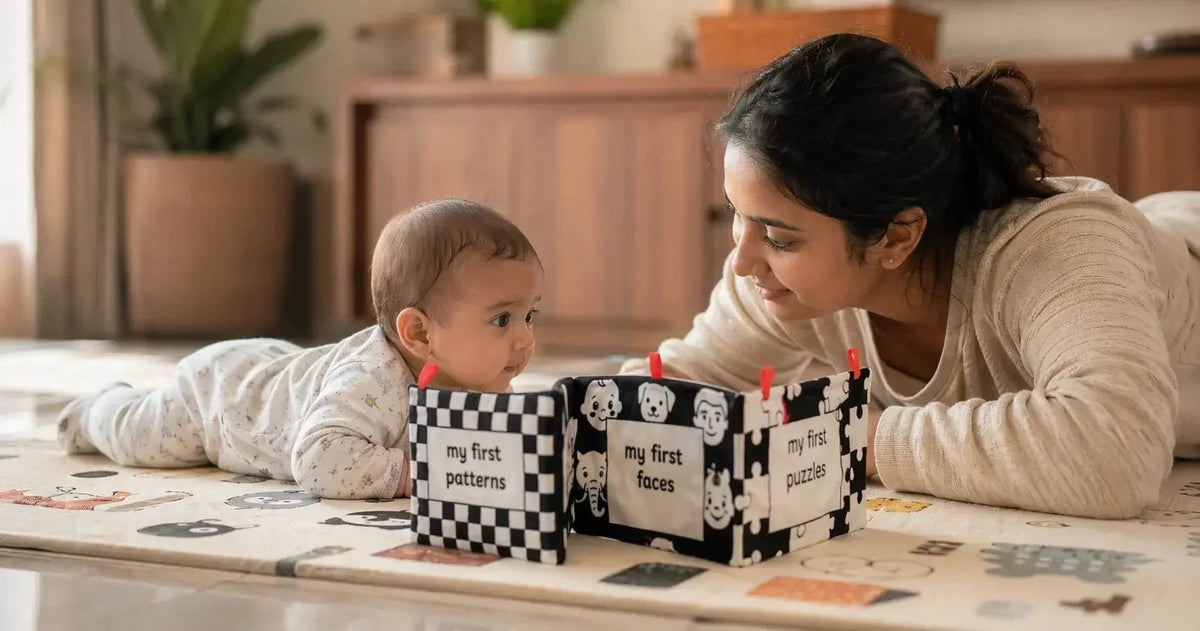
When you place a black and white flashcard at eye level during tummy time, your baby has motivation to lift their head and focus. They're building strength while simultaneously stimulating visual development and neural growth. It's not about drilling letters into an infant. It's about creating the conditions for optimal development.
The key is simplicity: a few minutes of focused interaction is far more valuable than overwhelming your baby with too many flashcards. Montessori principles emphasize quality over quantity, and that's exactly right here. One or two high contrast cards, rotated every few days, provides plenty of stimulation without overstimulating.

INTRODUCING HIGH CONTRAST TOOLS THAT GROW WITH YOUR BABY
Once you understand how important high contrast is for your baby's development, the question becomes: what products actually deliver on this promise?
At Nubokind, we've created a range of high contrast products specifically designed for Indian babies and families. Each product is guided by Montessori principles and developed with infant visual development in mind. They're not just pretty—they're purposefully designed for your baby's brain.
What makes our approach different is that we combine high contrast visual stimulation with safe, tactile materials. Your baby isn't just looking; they're feeling. Cloth books can be grabbed, chewed, and explored. This multi-sensory approach aligns with how infants naturally learn.
Nubokind High Contrast Cloth Book Set
BIS Certified | Soft, crinkle cloth pages | Perfect for tummy time & sensory play | Age: Birth to 6 months
₹699
These cloth books feature stark black and white patterns paired with bold geometric shapes—exactly what infant vision research tells us babies need. The soft, tactile material means your baby can safely grab, mouth, and explore without risk. No small parts, no harsh materials, just developmental support in a form your baby can hold.
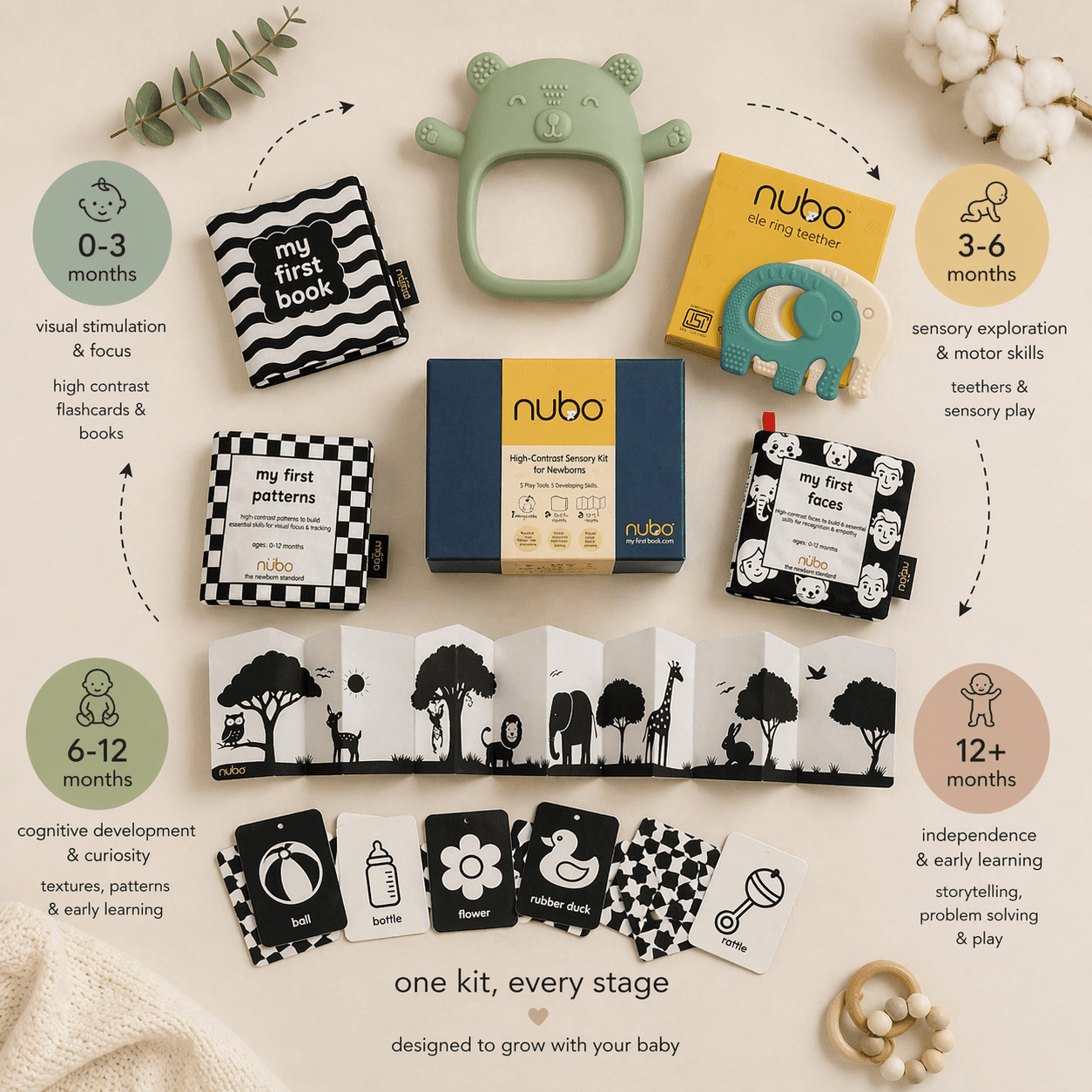
Nubokind High Contrast Newborn Essential Kit
BIS Certified | Complete sensory play set | Includes flashcards, cloth book, teether | Age: Newborn to 6 months
₹699
If you're building a complete sensory toolkit from scratch, this kit brings together everything we've discussed: high contrast flashcards for focused visual work, a cloth book for tactile exploration, and safe teething support as your baby develops. It's designed to support development across all the milestones we covered above.
WHAT PARENTS ARE SAYING
Kumari Adarsha
Totally worth it
My daughter is just 1.5 months old , and I'm using this flashcards and cloth book for her tummy time and it is a perfect product for newborn.
Payal Chaudhari
Amazing kit
Shapes and faces keeps my baby engaging with the book
FREQUENTLY ASKED QUESTIONS
Q: Aren't black and white flashcards too boring for my baby compared to colorful toys?
A: Not at all. Your newborn's brain is literally unable to process colors the way older babies do. What looks "boring" to you is actually perfectly calibrated to your baby's developing vision. That laser-focused attention you see? That's your baby's brain working hard. As they grow, you can gradually introduce colors, but the high contrast foundation is essential for visual development in the first 3-6 months. After that, you can blend high contrast with color.
Q: How long should I use high contrast flashcards with my baby?
A: There's no fixed timeline, but the sweet spot is typically birth through 6 months, with peak benefits between 4 weeks and 4 months. After 6 months, as your baby's color vision and pattern recognition mature, you can transition to higher-detail images, colored flashcards, and more complex picture books. Many parents continue using simple high contrast materials as part of a mixed sensory toolkit because babies still enjoy them.
Q: Will using flashcards on tummy time time actually help my baby learn to read earlier?
A: High contrast flashcards aren't a shortcut to early reading, and reading before age 4-5 isn't developmentally appropriate anyway. What these flashcards do is build the visual processing, attention span, and neural pathways that will support reading down the line. Think of it like strength training: you're not teaching reading, you're conditioning the brain systems that reading will eventually use.
Q: Are Nubokind's high contrast products safe for a newborn to mouth and chew?
A: Yes. All Nubokind products are BIS Certified and made from safe, non-toxic materials designed for infants. The cloth books use soft fabric with sturdy stitching, and there are no small parts, loose beads, or choking hazards. They're specifically designed for babies to grab, mouth, and explore safely. Still, as with any product, supervise your baby during use.
Q: How often should I rotate flashcards? Will my baby get bored?
A: Babies actually benefit from repetition and familiarity, so rotating every 3-5 days is ideal rather than changing daily. Repetition helps their brain consolidate learning. With just 2-3 high contrast cards in rotation, your baby stays engaged without being overwhelmed. If you notice decreasing interest, that's usually a developmental signal to gradually introduce new patterns or colors as your baby matures.
Q: Can I use high contrast images on my phone or tablet instead of physical flashcards?
A: While high contrast images on screens do provide visual stimulation, physical flashcards and cloth books offer something screens can't: safe tactile exploration. Babies learn through touch, and a cloth book allows your baby to grab, mouth, and manipulate the material—which supports hand-eye coordination and motor development. Screens are passive; physical materials invite active engagement. For optimal development, prioritize physical materials during the first 6 months.
CONCLUSION: START WITH WHAT YOUR BABY'S BRAIN ACTUALLY NEEDS
Black and white flashcards might seem simple, even outdated. But when you understand how your baby's vision develops and what their brain needs at each stage, high contrast becomes a no-brainer—not a trend.
The beautifully complex truth is this: you don't need fancy gear or complicated systems to support your baby's early development. You need tools that match their developmental stage. High contrast materials, used mindfully during tummy time and sensory play, do exactly that.
If you're ready to explore this for your baby, we invite you to explore Nubokind's High Contrast Cloth Book Set or the High Contrast Newborn Essential Kit. Both are designed by parents who understand the research, and both have been built with the principles we've discussed here in mind.
Your baby's visual system, brain, and capacity for learning are developing right now, in these early months. High contrast materials are a small investment in that foundation. Because the truth is: what you show your baby today shapes how they see the world tomorrow.
Start with high contrast. Watch your baby focus. And trust that you're doing exactly what their developing brain needs.

leave a comment
This site is protected by hCaptcha and the hCaptcha Privacy Policy and Terms of Service apply.