
You invested in a quality Montessori educational toy kit for your newborn. Now your baby is 7 months old, and you're wondering: is this still relevant? The truth is, you've only scratched the surface. Learn how to maximize every resource and watch your child continue to learn and grow.
THE GUILT OF "OUTGROWING" TOYS TOO FAST
Here's something no one tells first-time parents: you don't need to replace toys every three months. Yet most of us feel that creeping guilt when our babies stop reaching for their newborn teethers or lose interest in high contrast flashcards.
The problem isn't that your baby has moved on. The problem is that most toys are designed with a single developmental stage in mind. A teether becomes "just a toy," flashcards sit in a drawer, and cloth books gather dust because manufacturers assume babies want something new once they hit six months.
What if we told you that the best Montessori toys are actually designed to evolve WITH your child? That the newborn sensory kit you invested in can become a tool for learning, exploration, problem-solving, and even imaginative play?
WHY MONTESSORI PLAY KITS HAVE HIDDEN LAYERS OF VALUE
Montessori philosophy rests on one powerful idea: children don't need new things; they need the RIGHT things used in new ways. A high contrast flashcard isn't just for tummy time visual development. An infant cloth book isn't just for newborn engagement. And a teether? That's just the beginning.
When you buy quality montessori toys for newborns, you're investing in tools that support multiple developmental domains—motor skills, cognitive growth, language, and sensory processing. The trick is knowing how to pivot them as your child grows.
By re-using and re-purposing your play kit, you're also modeling sustainable mindfulness to your children—a core Montessori value. You're showing them that quality objects have multiple lives, not just one.
THE 5 GENIUS RE-USES FOR YOUR MONTESSORI PLAY KIT
1. From Tummy Time Tool to Independent Exploration Station
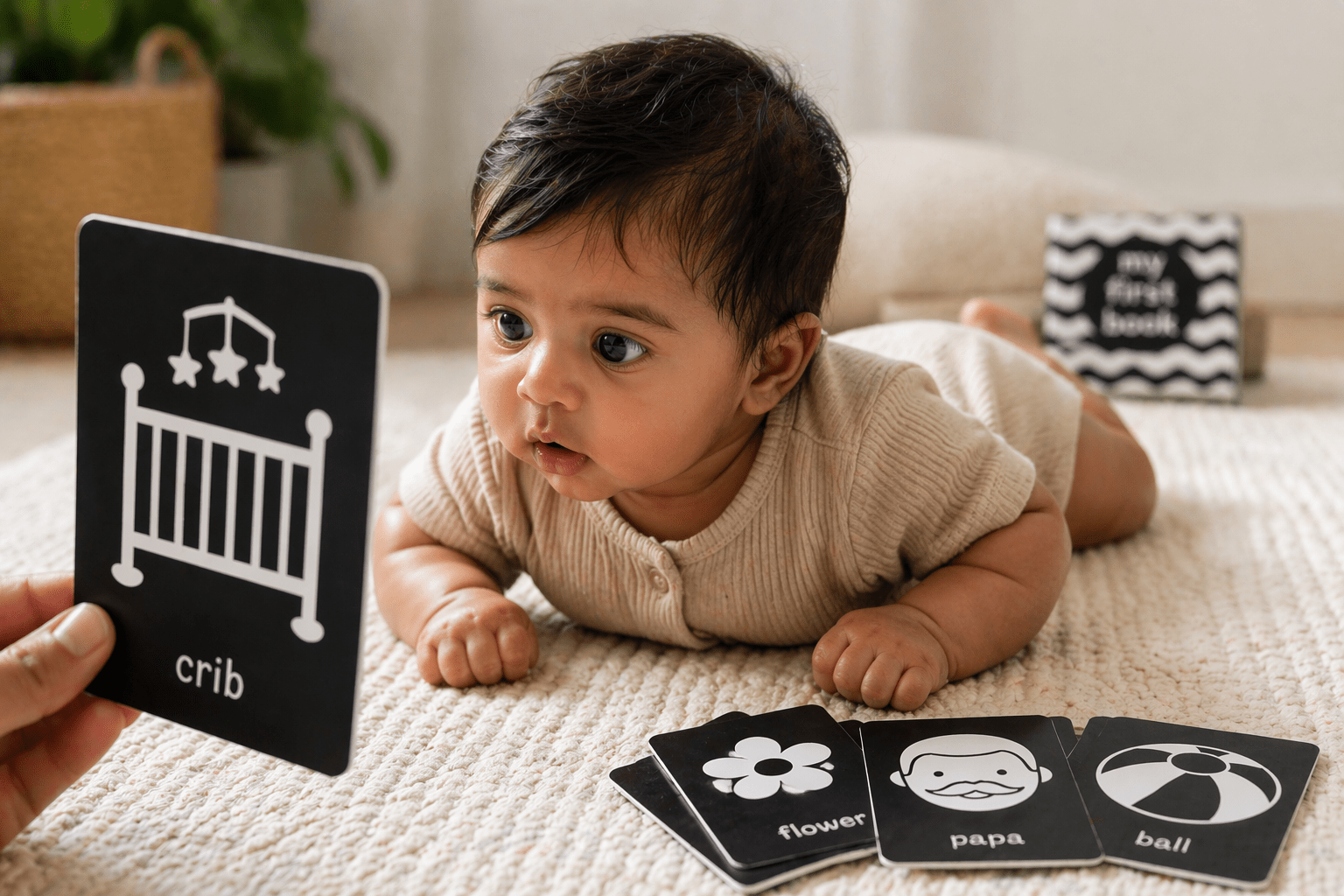
Newborn stage (0-4 months): Your high contrast flashcards and newborn teethers are essential for tummy time for newborn sessions. They build neck strength, encourage visual tracking, and soothe discomfort. This is their primary role.
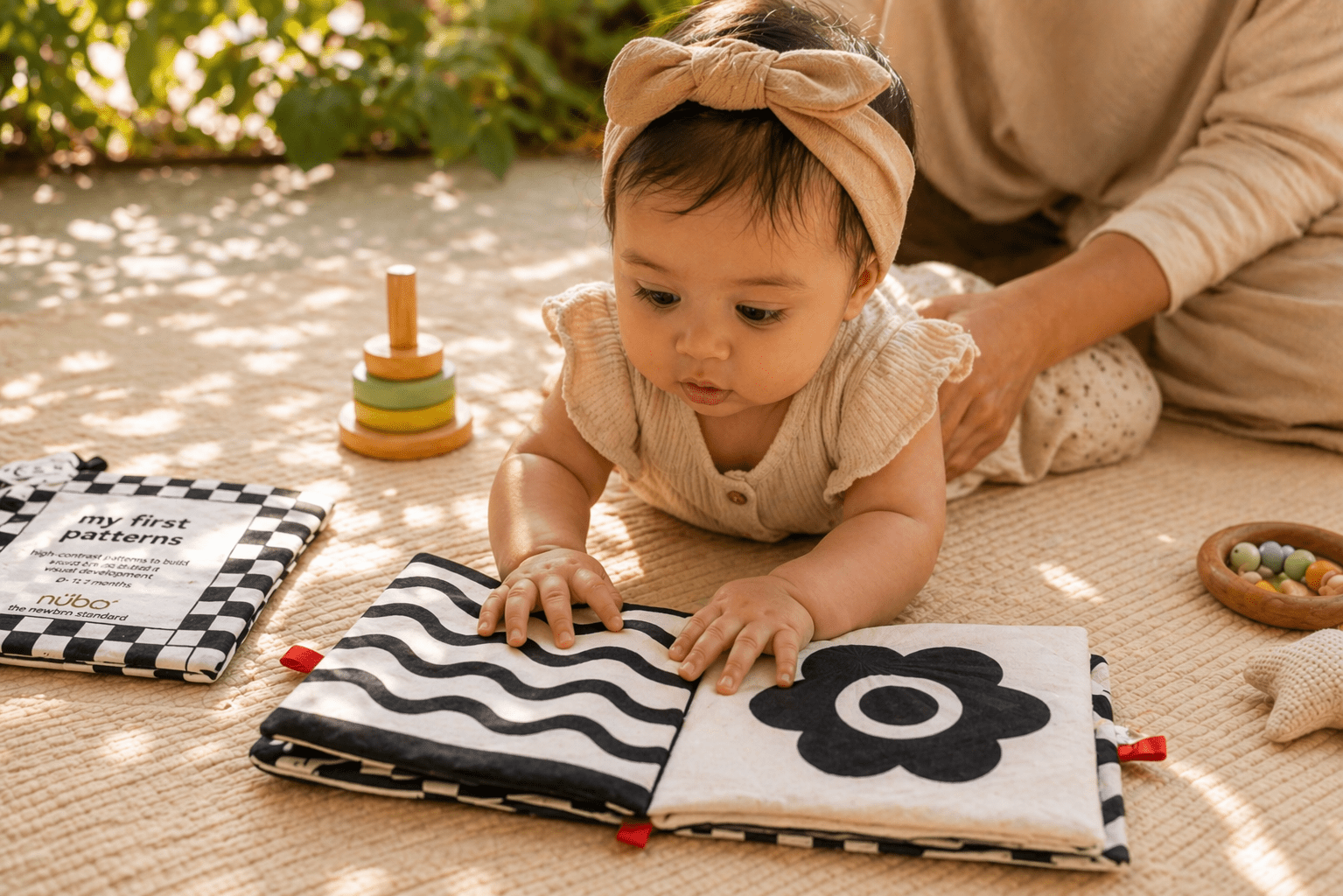
Transition stage (5-7 months): As your baby develops stronger motor control, these same items become tools for cause and effect learning. Instead of holding a teether for your baby, place it near them and watch them reach, grab, and mouth it independently. Your high contrast cloth book becomes a texture exploration—they'll pat it, mouth it, and learn about different sensations.
The shift: You're moving from passive sensory input to active discovery. Your baby is now the scientist; the toys are the laboratory.
2. From Visual Stimulation to Language Development
Newborn stage (0-3 months): High contrast images in newborn flashcards and high contrast books for newborns support infant visual development—their eyes track the patterns, neural pathways strengthen, and they begin to understand contrast and form.
Growing stage (6-12 months): Reframe these same flashcards as language tools. Point to shapes and patterns while naming them aloud. "Look! Circles. Red circles!" Your baby begins to associate visuals with words. An infant cloth book becomes a narrative tool—you tell stories about the patterns, and language centers in the brain light up.
The shift: Montessori educational toys transition from "look" to "listen and understand." You're scaffolding language through familiar, beloved objects.
3. From Teething Relief to Fine Motor Practice
Early stage (3-6 months): Teethers like the Kiko No-Drop Newborn Teether or ELE Ring Teether Set are first and foremost about relief—they numb sore gums and encourage safe mouthing.
Progression (7-12 months): As your baby's pincer grasp develops, those same teethers become fine motor tools. The varying textures and shapes encourage them to explore grip patterns. They learn to pass objects from hand to hand, to isolate fingers, and to understand spatial relationships. They're no longer just chewing—they're practicing the motor skills needed for self-feeding and writing later.
The shift: Teethers evolve from pain management to skill-building. A single object supports two vastly different developmental needs at different times.
4. From Solitary Sensory Play to Social Learning Tool
Solo stage (0-6 months): Your newborn engages with sensory toys individually—flashcards for their eyes, teethers for their gums, cloth books for their touch. This is healthy solo sensory exploration.
Social stage (7-12 months+): The same toys become bridges for interaction. Sit with your baby and explore a high contrast cloth book together. Take turns holding and exploring a teether. Play peek-a-boo using flashcards as props. Your baby learns about shared attention, back-and-forth interaction, and the joy of doing things together. These are the seeds of language and social-emotional development.
The shift: From solitary exploration to collaborative learning. Your presence transforms the toy from a solo tool into a relationship-building instrument.
5. From Developmental Tool to Imaginative Play Prop
Functional stage (3-8 months): Toys serve their explicit purpose—visual input, tactile sensation, teething relief. They're developmental tools with a clear job.
Imaginative stage (9-18 months+): Something magical happens around 9-10 months: the beginning of pretend play. A teether might become a "phone" your baby talks into. A cloth book becomes "food" for a stuffed animal. Flashcards become building blocks or sorting tools. Your baby is no longer using the toy as designed—they're using it as a springboard for creativity.
The shift: Objects transcend their intended purpose and become invitations to imagination. This is how children develop abstract thinking, creativity, and problem-solving skills.
HOW TO ACTUALLY IMPLEMENT THESE RE-USES (PRACTICAL GUIDE)
| Age Range | Primary Use | Secondary Use | Materials to Use |
|---|---|---|---|
| 0-3 months | Tummy time for newborn, visual development | Passive sensory input | High contrast flashcards, cloth books, teethers |
| 4-6 months | Teething relief, grasping practice | Texture exploration, cause & effect | Teethers (mouthing), cloth books (touch), all items (reaching) |
| 7-9 months | Fine motor development, object permanence | Language scaffolding, shared exploration | Teethers (gripping), flashcards (naming), books (storytelling) |
| 10-12 months | Social learning, interactive play | Early imaginative play, problem-solving | All materials (peek-a-boo, pretend, stacking, sorting) |
| 12+ months | Imaginative play, independent exploration | Language expansion, creative expression | All materials (props, building, storytelling, play scenarios) |
Pro tip: Don't pull everything out at once. Rotate your items monthly. When you "reintroduce" a teether your baby hasn't seen in two months, it feels brand new—even though you've owned it all along.
INTRODUCING NUBOKIND: DESIGNED FOR GROWTH FROM DAY ONE
This philosophy of multi-stage learning? It's built into every Nubokind product. Each item in our Nubokind collection is engineered with this evolution in mind.
Our high contrast cloth books aren't just pretty—they're scientifically designed to support infant visual development in the early weeks, then transition into vocabulary building and storytelling tools. Our teethers offer pain relief AND fine motor challenge across multiple stages. Our sensory kits are built on the principle that one object serves many purposes at many ages.
When you invest in Nubokind, you're not just buying products. You're investing in a multi-year learning system that grows with your child—and that respects both your family's budget and the planet.
Nubokind High Contrast Cloth Book Set
BIS Certified | Machine washable | 3-4 books per set | Newborn to 18+ months
₹699
Nubokind Kiko No-Drop Newborn Teether
BIS Certified | Silicone + wood | Safety tested | 3 months to 12+ months
₹649
Nubokind ELE Ring Teether Set
BIS Certified | Multiple textures | Varied sizes for different grips | 4 months to 12+ months
₹599
Nubokind High Contrast Newborn Essential Kit
BIS Certified | Complete sensory toolkit | Books, flashcards, teether combo | Newborn to 18+ months
₹699
WHAT PARENTS ARE DISCOVERING
Ujjwal
Just wanted to say that Urvika is having a gala time with her contrast books - she loves them and esp the bhopu inside 😂 A heartfelt thank you from her and 5/5 review for new customers 😄"
Payal Chaudhari
Best cloth books
Crinkle sound helps baby to engage more with the book 😍
FREQUENTLY ASKED QUESTIONS
Q: My baby is already 5 months old. Is it too late to start with montessori toys?
A: Absolutely not. While early intervention supports optimal development, every age has its own window of learning. A 5-month-old can benefit enormously from high contrast flashcards, cloth books, and teethers. You're not "behind"—you're simply entering the journey at a different point. The beauty of quality Montessori toys is they support learning across age ranges, not just in the newborn phase.
Q: How do I know my baby is actually learning from these toys, or are they just distracted?
A: Watch for signs of engagement, not just distraction: Does your baby reach for the item? Do their eyes track the high contrast images? Do they mouth and explore textures? Are they attempting to manipulate it in new ways? If you see any of these behaviors, learning is happening. Montessori learning isn't flashy or performative—it's quiet, focused exploration. That's when the deepest neural development occurs.
Q: Are high contrast flashcards and black and white books really necessary, or is this marketing hype?
A: The science is real. Newborns have immature color vision and can only focus on high contrast images initially. High contrast black and white photos and images literally support infant visual development in the first months. However, these tools aren't a substitute for parental engagement—they're most powerful when used alongside interaction (tummy time with you present, narration, exploration together). It's not about the products in isolation; it's about how you use them.
Q: Is there a risk my baby will get bored with the same toys if we re-use them across stages?
A: Quite the opposite. The human brain is wired to find novelty in familiar objects when they're presented in new contexts. A teether your baby "knew" at 4 months will feel entirely different at 9 months when their motor skills have evolved. Rotating toys and re-introducing them with new purposes actually prevents boredom and keeps learning sharp. Plus, research shows babies develop deeper learning with fewer, quality objects than with constant toy rotation.
Q: How do I clean and maintain infant cloth books and teethers if they're being used long-term?
A: Nubokind products are designed for longevity. Our cloth books are machine washable, and teethers can be easily wiped or sanitized. Regular gentle cleaning—especially between age stages—keeps them fresh and hygienic. The durability of quality Montessori toys means they actually improve over time as they soften from use, becoming even more inviting for growing babies. Proper care ensures they can even be passed to a second child.
Q: What happens when my child outgrows the imaginative play stage (around 18 months+)? Do these toys become obsolete?
A: Montessori materials have a beautiful third life: they become tools for learning concepts like sorting, stacking, color matching, and pattern recognition. A cloth book becomes a texture sorting game. Teethers become stacking toys. Flashcards become matching games. And if you have a second child, the entire cycle begins again. These toys are built to transcend age—they're generational investments, not disposable ones.
CONCLUSION
The moment you invest in quality Montessori educational toys, you're not just buying a product—you're embracing a philosophy. You're saying: "My child's learning isn't linear; it's layered. And I want tools that honor every stage of their growth."
Your newborn's high contrast flashcards aren't meant to be outgrown in three months. Your teethers aren't one-stage tools. Your cloth books aren't just for tummy time. Each item in your Montessori play kit is designed to evolve, to be re-purposed, and to support learning across years—not months.
When your baby is 14 months old and using a teether they've "grown past" in an entirely new way, you'll realize that this wasn't about buying more toys. It was about understanding that the best learning tools are the ones that grow with your child.
Ready to invest in toys that do more, last longer, and support genuine developmental growth? Explore Nubokind's High Contrast Newborn Essential Kit—a complete sensory system designed for every stage from newborn to 18+ months. Or explore individual pieces like our cloth book collection or teether sets to build your own system.
Your child is constantly growing. Your toys should grow too.

leave a comment
This site is protected by hCaptcha and the hCaptcha Privacy Policy and Terms of Service apply.