
Top 5 Tummy Time Activities for 0 to 3 Month Old Babies
Placing your baby on the floor and hoping they enjoy it is not really tummy time. It is just a baby on the floor. What turns tummy time into something your newborn will tolerate and then actually look forward to is having a plan — specific activities that match your baby's age, give them something to engage with, and make the prone position feel like playtime rather than a sentence.

Montessori Newborn Essentials Kit
Complete High-Contrast Starter Kit for Newborns
- ✓ High-contrast cards + cloth book + teether
- ✓ BIS-certified, safe from birth
These five activities are the most effective approaches for tummy time for newborns in the 0 to 3 month window. Each one works with your baby's current developmental abilities, and each one can be done using things you already have at home, plus a few well-chosen tummy time toys that genuinely make a difference.
Activity 1: Face-to-Face Floor Time
The most powerful tummy time activity for a young newborn requires no equipment at all. Get down on the floor yourself. Lie on your stomach, face-to-face with your baby at their eye level — roughly 8 to 12 inches between your faces. Talk to them. Make faces. Narrate what you see around you in a calm voice.
Your face is, without question, the most compelling visual stimulus in your newborn's world. When you are down at their level, your baby has a reason to lift their head that no toy can replicate. Most babies who fuss immediately when placed on their tummy will extend their session by several minutes when a parent is right there, talking and making eye contact.
This works from day one and remains effective throughout the 0 to 3 month period. It costs nothing, requires no preparation, and is the single best starting point for newborn and tummy time that feels positive rather than forced.
How long: Start with 2 minutes and build up. Follow your baby's cues.
Activity 2: Chest-to-Chest Tummy Time
This is how tummy time should begin for every newborn in the first two to three weeks of life. Recline on a sofa or bed at roughly a 45-degree angle. Place your baby face-down on your chest with their head near your collarbone and their cheek resting against you.
In this position, your newborn on tummy is working against gravity to lift their head just as they would on the floor, but with the comfort of your heartbeat, your warmth, and your familiar smell. The incline also makes it slightly easier for them to get their head up, which means less frustration and more success.
Chest-to-chest tummy time is particularly valuable for babies born early, babies with reflux, and babies who have had a difficult start with floor sessions. It builds the positive association with the prone position that makes the eventual transition to floor time much smoother.
How long: 3 to 5 minutes, multiple times a day. Works from birth.
Activity 3: High-Contrast Book Propped During Floor Time
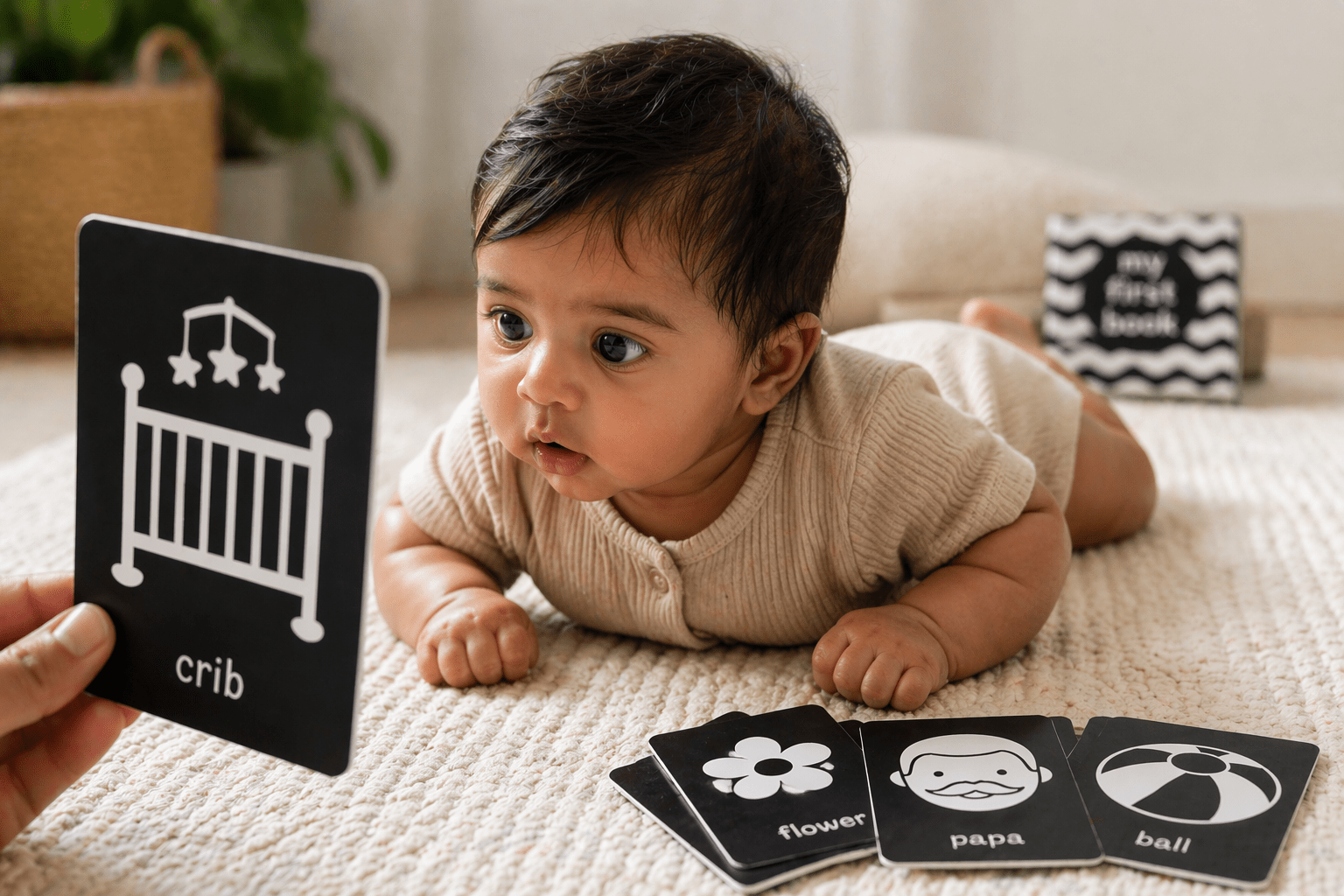
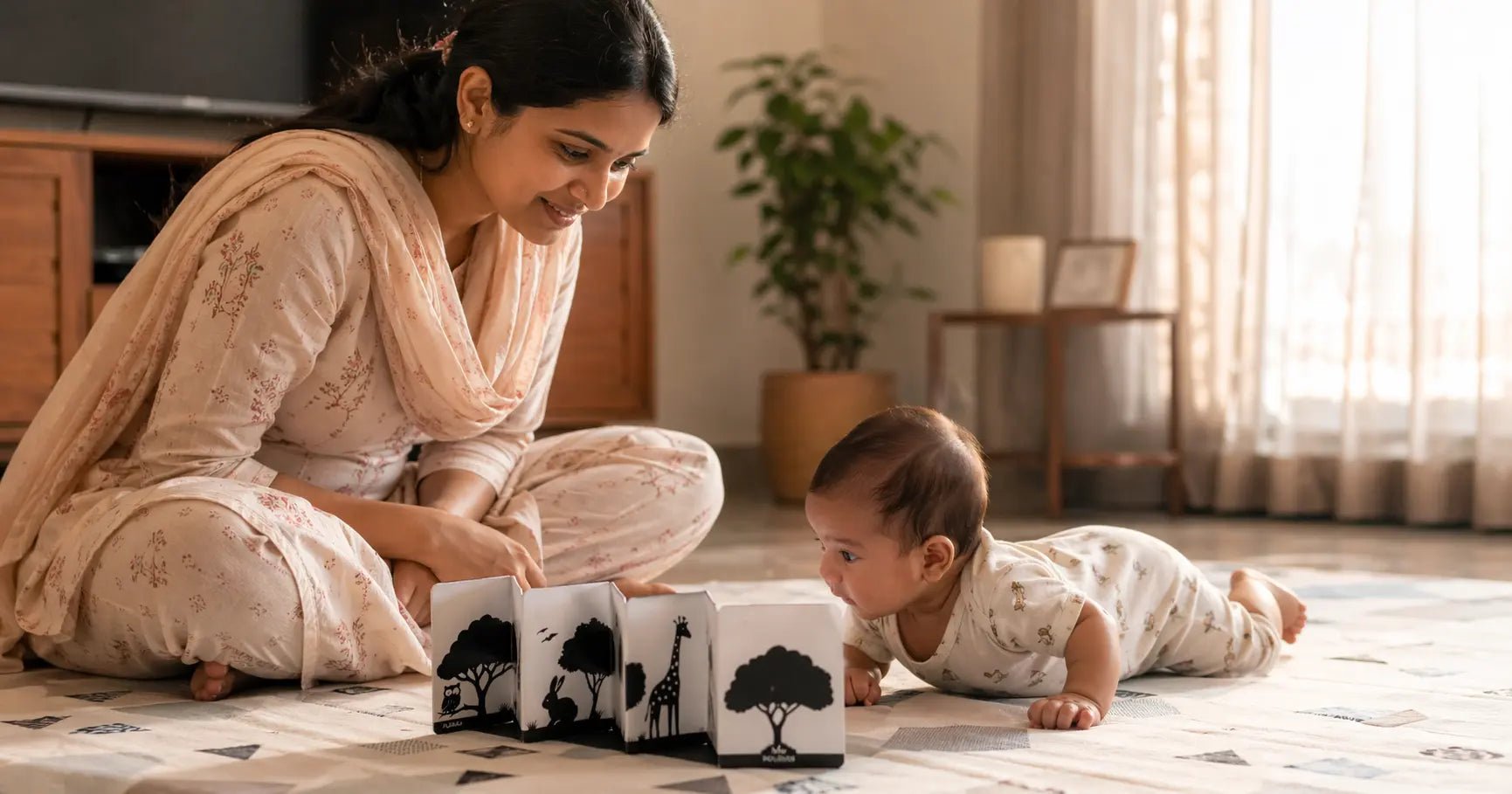
Once your baby is ready for floor sessions — typically from four to six weeks — introducing a high-contrast visual anchor transforms the experience. A tummy time session with nothing to look at is just effort. A session with a bold, high-contrast image propped 8 to 10 inches in front of your baby is effort with a reward.
Newborns at this age can only focus clearly at 8 to 12 inches. Their visual cortex is most stimulated by high contrast — sharp black and white patterns, bold edges, simple shapes. When a high-contrast cloth book is propped upright in front of a baby on their tummy, the natural response is to lift their head to look at it. That lift is exactly the neck-strengthening work that tummy time is designed to produce.
The Nubokind High-Contrast Cloth Book Set is one of the best tummy time toys for this purpose. The books stand upright easily, the pages have the bold patterns that newborn vision responds to most strongly, and as your baby grows from 0 to 6 months the same books continue to be useful across different developmental stages. Among toys for newborn to 6 months, a high-contrast cloth book delivers more developmental value per session than almost anything else.
How long: 5 to 10 minutes from 6 weeks onward. Prop the book close enough for your baby to focus on.
Activity 4: Lap Tummy Time With Gentle Patting
Sit upright on a chair or the floor with your knees together. Lay your baby face-down across your lap, their head just beyond your knee with their face turned gently to one side. Place one hand lightly on their back for security.
This lap position is an excellent middle step between chest-to-chest and full floor tummy time. Your newborn on tummy across your lap can feel you nearby, which is calming, while still getting the full neck-strengthening benefit of the prone position. The slight curve of your thighs also gives their chest a gentle support that makes head lifting a little easier.
Add gentle rhythmic patting or rubbing on your baby's back during this position. Many babies find the tactile input soothing enough to extend their tolerance for tummy time by two to three minutes beyond what they would manage on the floor. You can also use this position to sing or narrate, keeping your baby engaged through sound as well as touch.
How long: 3 to 5 minutes. Suitable from birth through to 3 months.
Activity 5: Mirror Play During Tummy Time
From around six to eight weeks, babies become intensely interested in faces — including their own. A small, baby-safe unbreakable mirror propped upright in front of your baby during floor tummy time triggers the same head-lifting response as a parent's face, but works even when you are not able to get down on the floor yourself.
Place the mirror 8 to 10 inches in front of your newborn and tummy time setup on the floor. Your baby will look at their own reflection with genuine curiosity, and that curiosity drives sustained head lifts. Babies often hold their heads up longer when looking at a mirror than at any other stimulus because the face in the reflection responds exactly as they do — creating a feedback loop of fascination.
The High-Contrast Newborn Essentials Kit includes a mirror panel specifically designed for this purpose, calibrated to the right size and distance for newborn tummy time sessions. As part of the broader range of toys for newborn to 6 months, it is one of the most used items in the kit because it remains relevant across multiple developmental stages.
How long: 5 to 10 minutes from 6 to 8 weeks onward.
How to Rotate These Activities
You do not need to choose one activity and stick with it. The most effective approach to tummy time for newborns is rotation — using different activities across different sessions during the day. Variety prevents your baby from becoming bored with a single stimulus and keeps each session feeling fresh.
A practical daily rhythm might look like this:
- Morning: Face-to-face floor time after the first nappy change
- Mid-morning: Chest-to-chest during a quiet moment after a feed has settled
- Afternoon: Cloth book propped session on the floor
- Evening: Lap tummy time before the bath routine
Four short sessions of 3 to 5 minutes each gives you 12 to 20 cumulative minutes — well on your way toward the 30-minute daily target. As your baby grows and their tolerance builds, each session extends naturally without requiring any effort on your part.
Frequently Asked Questions
What are the best tummy time activities for a newborn?
The most effective tummy time activities for newborns are face-to-face floor time with a parent at eye level, chest-to-chest tummy time on a reclined caregiver, and high-contrast visual anchors propped in front of the baby during floor sessions. These activities give your newborn on tummy a reason to lift their head, which is the core purpose of tummy time from a developmental standpoint.
What tummy time toys are best for 0 to 3 months?
The best tummy time toys for the 0 to 3 month stage are high-contrast cloth books, unbreakable baby-safe mirrors, and high-contrast flashcard sets. These work with your newborn's limited visual range of 8 to 12 inches and provide the bold patterns that a developing visual cortex responds to most strongly. Among toys for newborn to 6 months, high-contrast items are the highest-value investment because they remain useful across the entire first six months.
How do I make tummy time more enjoyable for my baby?
The biggest single change you can make is to get down to your baby's level. Lie on the floor facing them, make eye contact, and talk. Beyond that, introducing tummy time toys like a propped cloth book or mirror gives your baby something engaging to look at, which extends their tolerance naturally. Rotating activities across sessions also prevents the monotony that makes babies resistant.
How often should I do tummy time activities each day?
Aim for 3 to 5 short tummy time sessions spread across your baby's awake windows each day. For newborn and tummy time in the first month, 2 to 3 minutes per session is sufficient. By two to three months, work toward 5 to 10 minutes per session and a cumulative 30 minutes across the day. Anchoring each session to an existing routine, such as after a nappy change or before a bath, makes consistency easier to maintain.
When can I start using tummy time toys with my newborn?
You can introduce simple tummy time toys like a propped high-contrast cloth book from around four to six weeks, once your baby is ready for short floor sessions. Before that, face-to-face and chest-to-chest activities are the most effective approach. A high-contrast book or mirror can be introduced once your baby is showing visual tracking and spending time alert on the floor during supervised tummy time.

leave a comment
This site is protected by hCaptcha and the hCaptcha Privacy Policy and Terms of Service apply.