
Tummy Time for Newborns: Complete Guide for Indian Parents (When to Start + How Long)
The paediatrician has told you to do tummy time. Your mother-in-law is sceptical. Your baby screams the moment you put him face-down on the floor. And you are standing in your living room wondering if you are doing something wrong or if everyone in the history of Indian parenting somehow skipped this step.
You are not doing anything wrong. Tummy time for newborns is one of the most important daily habits you can build in the first six months of your baby's life, and the resistance most babies show at first is completely normal. This guide explains exactly what it involves, why it matters, when to start, how long each session should be, and most importantly, how to make it less miserable for both of you.
What Is Tummy Time and Why Does It Matter
Tummy time simply means placing your baby on their stomach while they are awake and supervised. No equipment required, no special training.
What makes it important is what happens in your baby's body during those minutes on their front. When a baby is placed on their tummy, they instinctively try to lift their head. That effort, even when it lasts only a few seconds, is doing several things at once:
- Strengthening the neck, shoulder, and upper back muscles that your baby will need to hold their head up steadily, sit independently, crawl, and eventually stand
- Preventing flat head syndrome (plagiocephaly), which can develop when babies spend too many hours on their backs, as they should for safe sleep
- Building the neurological pathways that connect physical effort to visual reward, the foundation of cause-and-effect learning
- Stimulating the vestibular system, the body's balance and spatial awareness network, which develops largely through position changes in early infancy
Indian paediatricians affiliated with the Indian Academy of Pediatrics (IAP) now consistently include tummy time in their guidance for newborn care, alongside safe sleep positioning. The two go together: back to sleep, tummy to play.
When Should You Start Tummy Time
The answer surprises most parents: from day one, or as soon as you are home from the hospital.
You do not need to wait until the umbilical cord stump has fallen off, until your baby has better head control, or until a specific milestone has passed. Infant tummy time can begin in the first week of life, in the gentlest possible form: placing your newborn chest-to-chest on your own body while you recline on the sofa or bed.
This position counts fully as tummy time. Your baby is prone relative to gravity, their neck muscles are working, and they are receiving all the developmental input without the cold, hard shock of a floor mat. It is also a wonderful position for skin-to-skin contact and settling a fussy baby.
The earlier you start, the more normal the position feels to your baby. Babies who begin tummy time in the first two weeks tend to tolerate and then enjoy it by the time they reach two months. Babies who start at three or four months, when they are more aware of their surroundings and more opinionated about what they dislike, often have a much harder adjustment period.
How Long Should Tummy Time Be: A Month-by-Month Guide
The target most paediatricians recommend is a cumulative 30 minutes of tummy time per day by the time your baby is three months old. Broken into short sessions across the day, it is very manageable.
0 to 2 Months: Short and Frequent
At this stage your newborn has very limited neck strength and will tire quickly. Aim for 2 to 3 minutes per session, 3 to 4 times a day. Watch your baby's cues closely. The moment they show signs of distress, pick them up.
The best times to do tummy time at this age are after a nappy change, after a brief wake window following a nap, or after the morning oil massage that many Indian families incorporate into their daily routine. Never do tummy time immediately after a feed as the pressure on a full stomach can cause discomfort and spitting up.
2 to 4 Months: Building Stamina
By two months, your baby's neck muscles are meaningfully stronger. You will notice they can lift their head briefly and turn it from side to side. Sessions can now extend to 5 to 10 minutes, still working toward 30 cumulative minutes across the day.
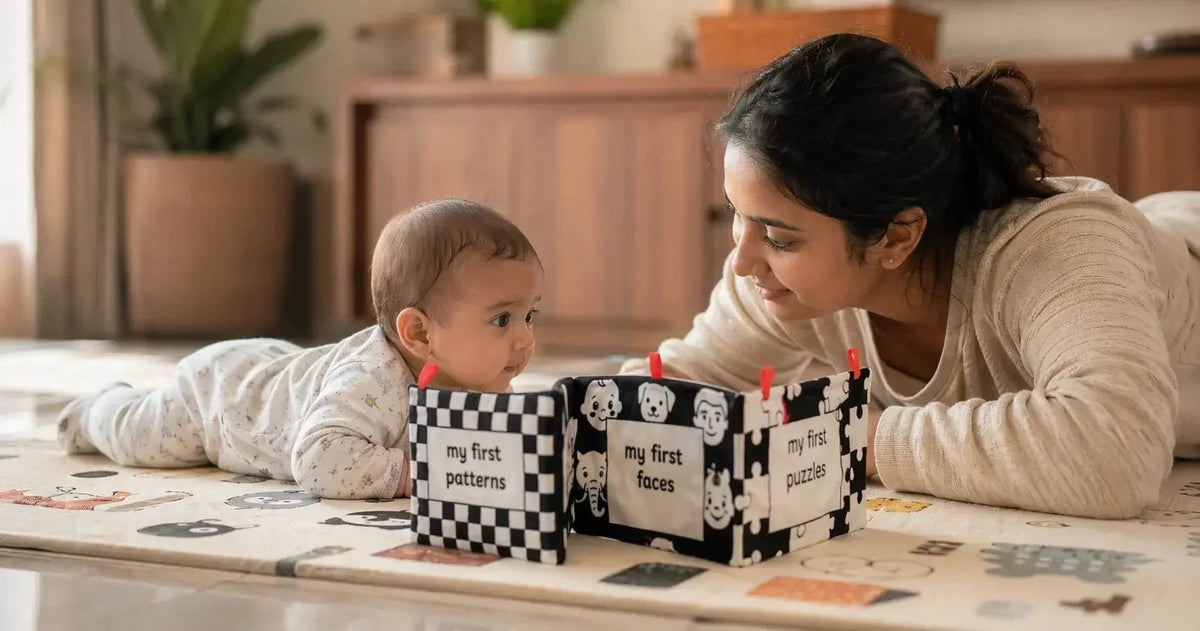
This is also the stage when propping a high-contrast book or card in front of your baby during tummy time becomes genuinely useful. The visual motivation to lift their head and look at a bold pattern turns exercise into exploration. It is a small shift that makes tummy time feel purposeful rather than punishing.
4 to 6 Months: Reaching the Target
By four months, many babies who have been doing regular tummy time will begin to push up onto their forearms, lifting not just their head but their chest off the floor. This is the beginning of the push-up progression that leads directly to crawling.
At this stage you can aim for sessions of 10 to 20 minutes, and your baby will likely start to show genuine enjoyment, reaching for objects, pivoting slightly, and making rolling attempts. The 30-minute daily target becomes easy to hit when tummy time is built into your routine.
The Best Positions for Tummy Time
Chest-to-Chest
Lie back at a 45-degree angle on a sofa or bed. Place your baby face-down on your chest, their head near your collarbone. This is the gentlest introduction to the prone position and works beautifully for very young newborns and babies who resist floor time. Your heartbeat and familiar smell are calming, and the slight incline makes it easier for them to lift their head.
Lap Position
Sit with your feet flat on the floor. Place your baby face-down across your thighs, their head resting near your knee with their face turned to one side. You can gently stroke their back and talk to them. This position gives you good visibility of their face and makes it easy to gauge their comfort level moment to moment.
Floor Time on a Mat
This is the classic form and the one that builds the most strength over time. Place your baby on a clean, firm surface — a yoga mat, a cotton play mat, or a folded cotton bedsheet on the floor. Place a rolled-up towel or muslin cloth under their chest if they need a little lift to get started. Kneel or sit directly in front of them at their eye level so your face is in their field of vision.
A firm surface is important. Soft mattresses or thick quilts actually make tummy time harder because the baby's face can sink in, which is frightening and restricts head movement.
What to Do When Your Baby Hates Tummy Time
Most babies fuss during tummy time at first. Some cry loudly from the moment they are placed down. This is so common it does not mean your baby is in pain or that you are doing something harmful.
These approaches genuinely help:
Start on your chest, not the floor. If floor tummy time causes real distress, go back to chest-to-chest for a week and try the floor again after that. The goal is to build a positive association, not to power through protest.
Get down to their level. Lie on your stomach facing your baby. Your face, voice, and expressions are the most interesting stimuli in your newborn's world. Having you there, talking softly, is often enough to extend a session by several minutes.
Use a visual anchor. A high-contrast book propped upright in front of your baby gives them something to focus on. The motivation to look at something interesting can override the discomfort of the position. The Nubokind High-Contrast Cloth Book Set works well here because the bold black-and-white pages are visible and engaging even for very young newborns.
Try after a nappy change. Many babies are briefly calm and alert after a fresh nappy. That two-to-three-minute window is ideal for a short tummy time session before feeding or sleep.
Build up in small increments. If your baby tolerates 30 seconds before crying, aim for 45 seconds the next day. Consistency matters more than duration at this stage.
Tummy Time in an Indian Household: Practical Notes
Can tummy time happen on a bed? A firm adult mattress is acceptable for supervised tummy time if the floor feels impractical. However, very soft beds or thick razais are not suitable because the surface gives way under the baby's face. A folded cotton bedsheet on the floor is the safest and most effective surface.
What about the daily oil massage? The post-massage, pre-bath routine in many Indian homes is actually an ideal time to incorporate tummy time. After the massage, while your baby is alert and the muscles are warm, a short prone session on a clean cotton mat flows naturally into the routine. Just ensure the massage oil has been mostly absorbed before placing them down, as a slippery surface reduces the friction their hands need to push against.
What if grandparents are uncomfortable with it? Older generations often associate placing a baby face-down with risk, primarily because safe sleep guidance was not widely available when they were raising children. It helps to explain the distinction clearly: tummy time is only for awake, supervised play. It is never for sleep. That one clarification usually resolves most concerns.
What about floor hygiene? Floor hygiene is a genuine consideration in Indian homes, especially during monsoon season or in areas with high dust. A dedicated cotton mat or muslin blanket kept clean and folded away between uses is a practical solution. There is no need for an expensive imported play mat.
The Best Props to Support Tummy Time
A rolled cloth or towel under the chest: For babies who struggle to lift their head, placing a tightly rolled muslin or hand towel under their chest just below the armpits gives them a small boost. This removes the barrier that frustrates young babies and makes them associate tummy time with failure.
A high-contrast visual anchor: Propping a high-contrast image or cloth book in front of your baby during floor time provides the visual motivation that makes head-lifting feel rewarding rather than effortful. The High-Contrast Newborn Essentials Kit includes the cloth book alongside high-contrast flashcards that can be propped at the right distance during tummy time sessions — giving your baby a full visual environment to explore while building strength.
Your own face: This costs nothing and remains the single most effective tummy time prop at every age. Get down on the floor, make eye contact, and talk to your baby. There is no app, toy, or gadget that competes with a parent's face for a newborn's attention.
Frequently Asked Questions
When should I start tummy time for my newborn?
You can start tummy time for your newborn from the very first week at home. Begin with chest-to-chest tummy time, where you recline at a 45-degree angle and place your baby face-down on your chest. This gentle introduction builds the habit before floor-based tummy time begins. The earlier you start, the easier the transition to floor time becomes.
How long should infant tummy time sessions be?
For newborns aged 0 to 2 months, aim for 2 to 3 minutes per session, 3 to 4 times a day. By 2 to 4 months, extend sessions to 5 to 10 minutes. By 4 to 6 months, work toward 10 to 20 minute sessions. The overall daily target is 30 cumulative minutes by the time your baby is three months old. Short, frequent sessions are far more effective than one long session.
Is tummy time safe for newborns in India?
Yes. Tummy time is recommended by the Indian Academy of Pediatrics for all healthy newborns, starting from the first days of life. The key rule is that tummy time is only for babies who are awake and supervised. It is never for sleep. On a firm, clean surface with a caregiver present, tummy time is completely safe and developmentally essential.
What if my newborn hates tummy time?
Most babies resist tummy time initially. Start with chest-to-chest sessions on your body rather than the floor, and build up gradually. Get down to your baby's eye level so your face is in their field of vision. Place a high-contrast cloth book or image in front of them to give them a visual reason to lift their head. Consistency over a few weeks usually results in a baby who tolerates and then enjoys the position.
Does newborn and tummy time really need to start from birth?
Yes, and starting early is strongly recommended. Babies who begin tummy time in the first two weeks of life adapt to it far more readily than those who start at two or three months. Early tummy time builds the neck and shoulder strength needed for every subsequent gross motor milestone, from holding the head steady to sitting, crawling, and standing. It is one of the simplest and most impactful habits you can build in your baby's first months.


leave a comment
This site is protected by hCaptcha and the hCaptcha Privacy Policy and Terms of Service apply.