
Every parent wonders: Is my baby developing at the right pace? This month-by-month guide breaks down physical, cognitive, and sensory milestones from birth to age 2, with practical tips to support your baby's growth—and reassurance that every child's timeline is their own.
Why Milestone Tracking Matters (But Shouldn't Stress You)
First, take a breath. Milestone guides aren't meant to alarm you—they're meant to reassure you. They help you understand what's typically expected, what's normal variation, and when it might be worth chatting with your pediatrician.
Every baby is unique. Some roll over at 4 months, others at 6. Some babble at 3 months, others at 5. Development isn't a race; it's a spectrum. What matters most is that your baby is progressing, engaging with you, and slowly expanding what they can do.
Research indicates that early sensory play—from high-contrast visuals to safe teething toys—supports healthy cognitive and motor development. This guide will show you how to recognize milestones and naturally support your baby's growth through everyday activities and play.
Newborn to 3 Months: Birth, Reflexes & First Smiles
Physical Development: Your newborn arrives with built-in reflexes—rooting, sucking, grasping. By 8 weeks, they're lifting their head briefly during tummy time. By 3 months, head control is improving, and they can track objects with their eyes.
Cognitive & Social Development: Newborns spend most time sleeping, but they're absorbing everything. By 6 weeks, you'll see that magical first smile (not gas, we promise!). By 3 months, your baby is beginning to recognize your face and voice, even coo-ing back at you.
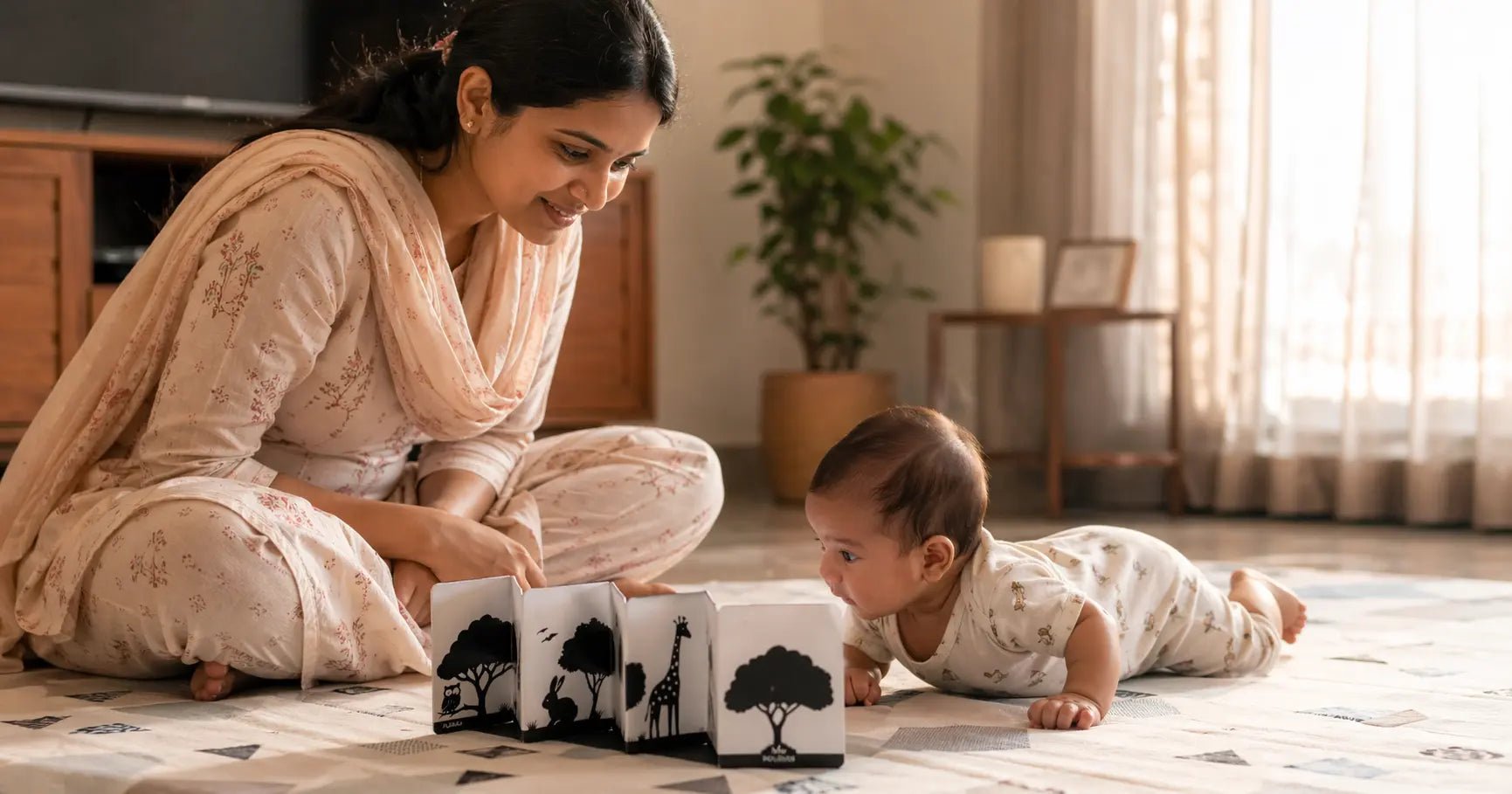
Sensory Milestones: Newborns see best at 8–12 inches away. High-contrast black-and-white images capture their attention naturally—think of them as visual "food" for developing brains. Their hearing is acute, and they're starting to reach for objects (though coordination is clumsy).
How to Support This Stage: Talk, sing, and make eye contact during feeds. Use high-contrast cloth books during alert times. Keep sensory moments short—newborns tire quickly.
4 to 6 Months: Rolling, Reaching & Early Teething
Physical Development: By 4 months, most babies can roll from back to side. By 5–6 months, rolling both ways is typical. Tummy time strengthens, and sitting with support becomes possible. Reaching becomes intentional—they're grabbing toys, your hair, your glasses.
Cognitive Development: Your baby is now fascinated by cause and effect. Drop a toy, you pick it up, drop it again—endlessly. They're developing object permanence (understanding that things exist even when hidden). They're also starting to babble with consonant sounds: "ba-ba," "da-da."
Sensory & Teething: Around 4 months, many babies start drooling and chewing—early signs of teething (though teeth might not appear until 6+ months). Gums become tender. Silicone teethers and safe chewing toys become essential. Babies also love exploring textures, so soft, washable toys are ideal.
How to Support This Stage: Offer teethers designed for small hands. Create a safe play space where they can explore freely. Continue sensory play with cloth books and textured toys.
| Age (Months) | Key Physical Milestone | Cognitive Sign | Sensory Activity |
|---|---|---|---|
| 0–3 | Head control improving, tracking objects | Recognizes faces, first smiles | High-contrast images, listening to voices |
| 4–6 | Rolling over, intentional grasping | Cause & effect, babbling | Teething toys, textured cloth books |
| 7–9 | Sitting alone, crawling begins | Object permanence, stranger awareness | Exploration toys, safe household objects |
7 to 9 Months: Crawling, Babbling & Stranger Anxiety
Physical Development: Sitting independently is now solid. Crawling—whether traditional or scooting—begins. Some babies might even start pulling up to stand using furniture. Balance and coordination are developing rapidly. They're also becoming more intentional with hand movements, using thumb and fingers to pick up tiny objects (the "pincer grip").
Cognitive Development: Object permanence is fully emerging—your baby now understands you still exist when you leave the room (which is why separation anxiety can kick in). They're imitating sounds and gestures. They understand "no" even if they don't always listen. They're also developing preferences—favorite toys, favorite foods, favorite people.
Sensory & Teething: Teething intensity often peaks. Gums may be swollen and tender. Many babies cut their first teeth around 6–7 months, but every baby is different. Your baby is also more curious about exploring everything—textures, tastes, sounds. They want to see how things work and what happens when they drop them.
How to Support This Stage: Babyproof your space thoroughly. Offer ring teethers with varied textures to soothe gums. Encourage crawling by creating safe exploration zones. Play peek-a-boo to support object permanence understanding.
10 to 12 Months: Standing, First Words & Pincer Mastery
Physical Development: By 10 months, pulling up to stand is common. By 12 months, many babies are cruising (walking while holding furniture). Some walk independently by their first birthday; others aren't ready until 15–18 months—both are normal. Fine motor skills have also progressed: they can point with one finger, put objects in and out of containers, and manipulate toys with purpose.
Cognitive & Language Development: First words often emerge around 12 months, though some babies wait until 18 months. Before actual words, babies understand far more than they say. They respond to their name, understand "no," and follow simple directions like "wave bye-bye." They're also developing a sense of humor—they find repetition hilarious and love playing games.
Sensory Development: Your baby is now actively exploring—opening drawers, dumping containers, stacking objects. Sensory play becomes more sophisticated. They're learning about cause and effect through experimentation. They're also developing preferences for tastes, textures, and sounds.
How to Support This Stage: Encourage cruising and walking with safe furniture. Offer toys that support stacking, sorting, and exploration. Play music and dance together. Read cloth books together, pointing to pictures and naming objects aloud.
13 to 18 Months: Walking, Pointing & Language Explosion
Physical Development: Most children are walking independently by 15–18 months. They're climbing on furniture, running (with wobbly balance), and starting to throw balls. Coordination is improving, and they can turn pages in books (often multiple pages at once). They're also feeding themselves—with a spoon, with fingers, with varying degrees of success.
Language & Cognitive Development: This is when vocabulary often explodes. Babies might go from 5 words to 50+ words in a few months. They're also understanding categories—animals say sounds, vehicles go places. They're following two-step directions. They're testing cause and effect with enthusiasm—pressing buttons, turning dials, knocking things down.
Social & Emotional Development: Toddlers are becoming more independent and assertive. They have opinions and aren't shy about expressing them. They're also becoming more aware of others' emotions and may show early empathy. Parallel play (playing near other children but not quite with them) is typical.
How to Support This Stage: Name objects and actions throughout the day. Offer books with clear, labeled pictures. Provide safe exploration opportunities. Play simple games like "where is it?" Point out body parts and animal sounds. Celebrate attempts at new skills, even when messy or imperfect.
19 to 24 Months: Running, Sentences & Pretend Play
Physical Development: By 24 months, most toddlers are confident walkers and runners. They can kick a ball, climb stairs with support, and jump (though landing is wobbly). Fine motor skills continue improving: they can scribble intentionally, turn pages one at a time, and build towers of blocks. Hand-eye coordination is much more reliable.
Language & Cognitive Development: Two-word sentences emerge ("more milk," "daddy home," "mine!"). Vocabulary typically reaches 50+ words, sometimes much more. Toddlers are asking "why?" and "what's that?"—endlessly. They're developing a sense of humor that goes beyond simple repetition. They're also beginning to understand basic concepts like "big" and "small," colors, and numbers (though "counting" is often just reciting sounds).
Social & Emotional Development: Toddlers are becoming more independent, which often comes with frustration and big emotions. They're showing affection openly, playing alongside other children, and beginning to engage in simple pretend play. They're also developing a sense of self and ownership (everything is "mine").
How to Support This Stage: Read books together regularly—toddlers love repetition and may have favorites they want read dozens of times. Encourage pretend play with safe household objects and toys. Answer questions patiently. Name feelings: "You're frustrated because the block tower fell." Support independence while maintaining gentle boundaries.
Quick Tips for Supporting Development at Every Stage
- Talk constantly. Narrate your day: "Now we're changing your diaper. I'm using a clean one." Babies absorb language even before they speak.
- Offer safe exploration. Babyproof thoroughly, then let them explore. Bumps and tumbles are part of learning.
- Use varied textures and sensory toys. Silicone teethers, cloth books, and textured toys support sensory development and keep boredom at bay.
- Play together, but don't over-direct. Let your baby lead play. Follow their interests. Your presence and engagement matter more than the "right" toy.
- Keep routines consistent. Predictability helps babies feel secure and supports cognitive development.
- Trust your instincts and pediatrician. If something feels off, ask your doctor. Every baby is different, and early support makes a difference.
Developmental Red Flags: When to Check In with Your Pediatrician
Most developmental variations are perfectly normal, but some signs might warrant a conversation with your pediatrician. This isn't about alarm—it's about early support. Many developmental delays benefit tremendously from early intervention.
General concerns across all ages: Not responding to their name by 12 months, not making eye contact, loss of skills they once had (regression), extreme difficulty with transitions, or persistent feeding difficulties. By 18–24 months: Fewer than 10–20 words, not following simple directions, or not showing interest in other people.
If something feels off, trust your gut. Early intervention services are available in most areas and can provide free assessments. No harm in checking—and early support, if needed, makes a real difference.
Frequently Asked Questions
Q: My baby isn't rolling over yet at 5 months. Is that a problem?
A: Probably not. Rolling typically happens between 4–6 months, with wide variation being completely normal. Some babies roll early; others take longer. What matters more is steady progress—is your baby doing more each week? If they're engaging, making eye contact, and developing in other ways, delayed rolling alone usually isn't a concern. That said, if you're worried, mention it to your pediatrician at the next visit.
Q: When should my baby start teething, and how can I help?
A: Teething can begin as early as 3–4 months (with excessive drooling) but often doesn't produce visible teeth until 6–12 months. Offer cold (not frozen) silicone teethers—cold soothes inflamed gums. Ring teethers with varied textures give babies options for exploring what feels best. Gently rub their gums with a clean finger if they seem to like it. Avoid products with pain relievers unless recommended by your pediatrician.
Q: How much talking should I be doing with my baby? Isn't it okay to use screens sometimes?
A: Talk as much as you naturally can—there's no such thing as too much. Language exposure in the first few years builds brain architecture. Screens aren't inherently harmful in small amounts, but research indicates interactive play and conversation support language development far more effectively. Aim for conversation-rich moments: during meals, diaper changes, and play. Use high-contrast cloth books and sensory toys that invite you to interact and narrate together.
Q: My 10-month-old isn't saying words yet. Should I worry?
A: Not necessarily. First words typically emerge around 12 months, but the range is 9–18 months for typically developing babies. What matters is comprehension—do they understand "no"? Do they respond to their name? Do they point and show you things? Do they make sounds and babble? If they're doing these things, language will likely follow. If you're concerned about hearing or if there's no babbling by 10 months, mention it to your pediatrician.
Q: Is there a "best" toy for newborns developing normally?
A: Not one "best" toy, but newborns benefit from variety. High-contrast visuals (black, white, bold patterns) support early visual development. Safe silicone teethers support oral exploration. Soft cloth books invite interaction and language building. The Newborn Gift Kit combines these elements to support early sensory and cognitive development. More important than the toy itself is your engagement—playing together, narrating, and responding to your baby's cues matters most.
Q: How do I know if my baby is developing "normally" versus needing support?
A: Development isn't binary—it's a spectrum. "Normal" ranges widely. What matters most is consistent progress in some direction: Are they doing more this month than last month? Are they engaged with people? Are they exploring? Are they showing curiosity? If yes to these, they're likely on track. If you notice stagnation, loss of skills, or significant gaps across multiple areas (not just one skill), chat with your pediatrician. Early support, if needed, works best.
Supporting Development with Thoughtful Play & Products
You don't need an endless array of toys to support healthy development. What matters most is safety, variety, and your presence. High-quality sensory toys that invite exploration—cloth books with contrast, safe teethers with varied textures, toys that make different sounds—keep babies engaged and support multiple developmental areas at once.
When choosing toys and products for newborns and young babies, look for items that support their current stage while offering some growth. Nubokind products are designed with early development in mind—from high-contrast cloth books that capture newborn attention to teethers that support sensory exploration at 4+ months.
But honestly? Your voice, your face, and your engagement are the most powerful tools for development. Toys are wonderful helpers, but you're the main event.
Conclusion
Every baby develops at their own pace, and that's not just acceptable—it's normal. This guide is meant to be reassuring, not prescriptive. If your 5-month-old isn't rolling, your 12-month-old isn't walking, or your 18-month-old has just a few words, you're not alone. Most of these children are developing perfectly well.
What matters is progress, engagement, and support. Talk to your baby. Play with them. Offer varied textures, sounds, and visuals. Trust your instincts. And if you have concerns, ask your pediatrician—that's what they're there for.
Your baby is unique, and their developmental timeline is theirs. You're doing a great job noticing, supporting, and caring about their growth. That's what matters most.


leave a comment
This site is protected by hCaptcha and the hCaptcha Privacy Policy and Terms of Service apply.