
High Contrast Flashcards for Newborns: Stage-by-Stage Guide (0–6 Months)
Quick Answer
High contrast flashcards for newborns should be held 8–12 inches from your baby’s face for 3–5 minute sessions starting from day one. Show geometric black & white patterns in weeks 1–4, add face cards from month 2, and real-world object cards from month 3. Rotate 3–4 cards per session, 1–3 times daily.


Why Flashcards — And Why High-Contrast Specifically
At birth, a baby's visual acuity is approximately 20/600. The retina is immature, and the visual cortex — the brain's processing center for sight — has not yet learned to interpret visual signals. The brain begins this learning process immediately, forming new neural connections every time it receives clear visual input.
The key word is clear. A newborn's brain cannot yet distinguish subtle color differences. Pastels, soft illustrations, and brightly colored toys provide a weak, blurry signal to the immature visual cortex. High-contrast black and white patterns, by contrast, provide the sharpest possible signal — activating more neural connections per minute of exposure than any color-based alternative.
Flashcards deliver this signal in a format that is portable, adjustable, and parent-controlled — making them more versatile than a static poster or mobile.
The Fundamentals: Before You Start
Always Hold Cards 8–12 Inches From Your Baby’s Face
- This is the optimal focal distance for newborn visual acuity — roughly the distance to a parent’s face during feeding.
- Objects held further away appear blurry to a newborn due to immature retinal development.
- When hanging cards on a crib, play gym, or stroller, always measure and position them at this distance — not wherever is convenient.
Use Flashcards During Alert, Calm Windows — Not Before Sleep or When Hungry
- A baby can only benefit from visual stimulation when they are in an alert, content state — not drowsy, fussy, or hungry.
- The ideal window is 20–30 minutes after a feeding, during the natural alert period most newborns have.
- Session length: 3–5 minutes in months 1–2. Extend to 5–10 minutes from month 3 as attention span grows.
Follow Your Baby’s Lead — Looking Away Means the Session Is Over
- When a baby looks away from a card, they are not being distracted — they are communicating that they have processed the image and need a break.
- Never force continued engagement. End the session when your baby disengages.
- Quality of focused engagement matters far more than duration. A 2-minute session of genuine focused gaze is more developmentally productive than 10 minutes of forced exposure.
Stage-by-Stage: Exactly What to Do Each Month
First Exposure — Geometric Patterns Only
At this stage, the baby sees primarily black, white, and grey. The visual cortex is primed for simple, bold, high-contrast geometric patterns — stripes, chevrons, spirals, and checkerboards.
- What to show: Abstract geometric patterns only. No faces, no objects yet — the brain is not ready to process them as meaningful.
- How: Hold one card at 8–12 inches. Allow 30–60 seconds of gaze. Show 1–3 cards per session. Repeat 1–3 times per day.
- What you will notice: Your baby will stare intently at the card — sometimes for longer than seems normal. This is active neural processing. It is a good sign.
- Gallery mode: Use the linking ribbon to hang 2–3 geometric cards on the crib at the correct distance. This provides passive visual stimulation during natural alert periods without requiring you to hold the cards.
Tracking Practice — Build the Eye Gym Habit
The magnocellular pathway — the neural system responsible for detecting edges, shapes, and motion — begins activating more efficiently. The brain is now ready for moving targets.
- Add tracking: Slowly move a card from left to right across your baby’s visual field at 8–12 inches. Pause when they fix their gaze. Move again. This is the Eye Gym.
- Why it matters: Smooth pursuit — the ability to follow a moving object smoothly — is the same eye movement skill used to follow lines of text while reading. You are building a reading foundation right now.
- Tummy time: Place a card upright in front of your baby at eye level during tummy time. The visual target motivates head-lifting — extending tummy time naturally.
- Speed: Move cards very slowly — one full sweep (left to right) over 3–5 seconds. Too fast overwhelms the tracking system; too slow provides no tracking challenge.
Introduce Faces — The Brain’s Face System Activates
Around 6–8 weeks, the brain’s dedicated face-processing system begins activating. Faces become the most compelling visual stimulus available — more than any geometric pattern.
- What to add: High-contrast face cards — Mama, Papa, and stylised human face illustrations. Keep using geometric cards alongside them.
- Narrate: Say “Mama” when showing the Mama card. “Papa” for the Papa card. Narration begins building the neural bridge between visual recognition and language — even though your baby cannot speak yet.
- Your own face: Alternate between holding a face card and holding your own face at the same distance. Your face is the most powerful developmental stimulus available — and it is free.
Real-World Objects — Cognitive Association Begins
Bold primary colors — red, green, blue — become visible as cone cells function more effectively. The brain begins building its first cognitive associations between visual patterns and real-world objects.
- What to show: Labeled real-world object cards — Bottle, Spoon, Rattle, Crib. These trigger the association centers of the brain because your baby has direct lived experience with these objects.
- The naming bridge: Show the Bottle card before or after feeding. Show the Crib card before sleep. Contextual timing accelerates association — the brain connects the visual pattern to the real experience.
- Introduce bold color: If you have bold primary color cards, now is the time to introduce them. Keep high-contrast B&W cards in rotation — do not replace them entirely.
Gallery Mode and Object Recognition Games
Visual acuity is approaching 20/25. Babies can now see across a room and track fast-moving objects. Attention span has grown significantly — sessions can be longer and more interactive.
- Gallery sequences: Use the linking ribbon to create a gallery of 4–6 cards on the play gym. Let your baby scan the sequence during alert time. The brain is now processing each image as a distinct concept.
- Object recognition games: Hold two cards at once — “Where is the Bottle?” Watch your baby’s gaze shift to the correct card. This is the beginning of receptive language comprehension.
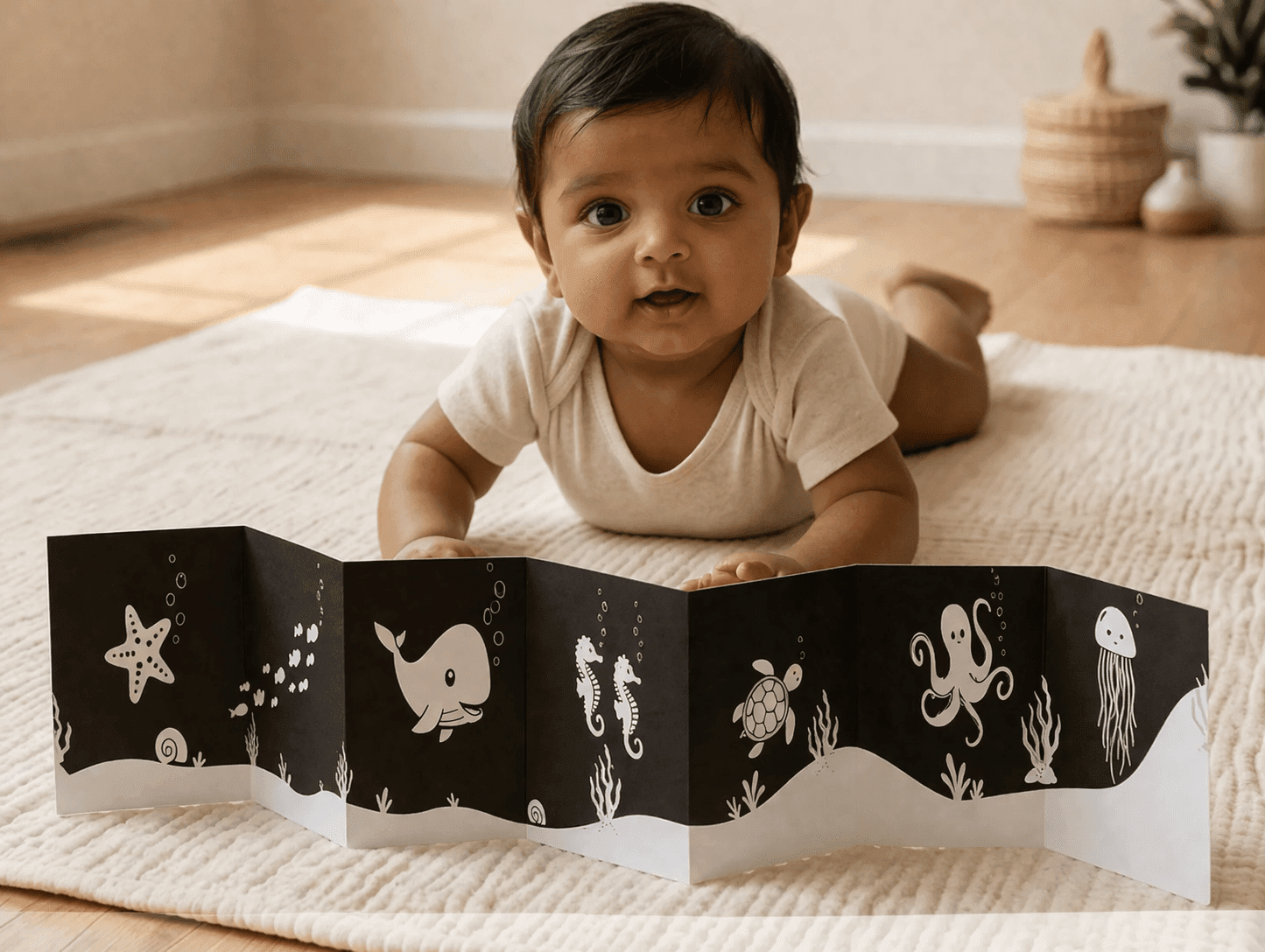
- Tummy time with the fold-out book: Place the self-standing fold-out book and a gallery of cards in a semi-circle during tummy time. Variable distances and heights give the developing depth perception system new data to work with.
- Bonding narration: Tell stories about the cards. “This is a rattle — you have one just like this.” Connecting the visual to the verbal to the physical object accelerates cognitive and language development simultaneously.
How to Set Up a Crib or Play Gym Flashcard Gallery
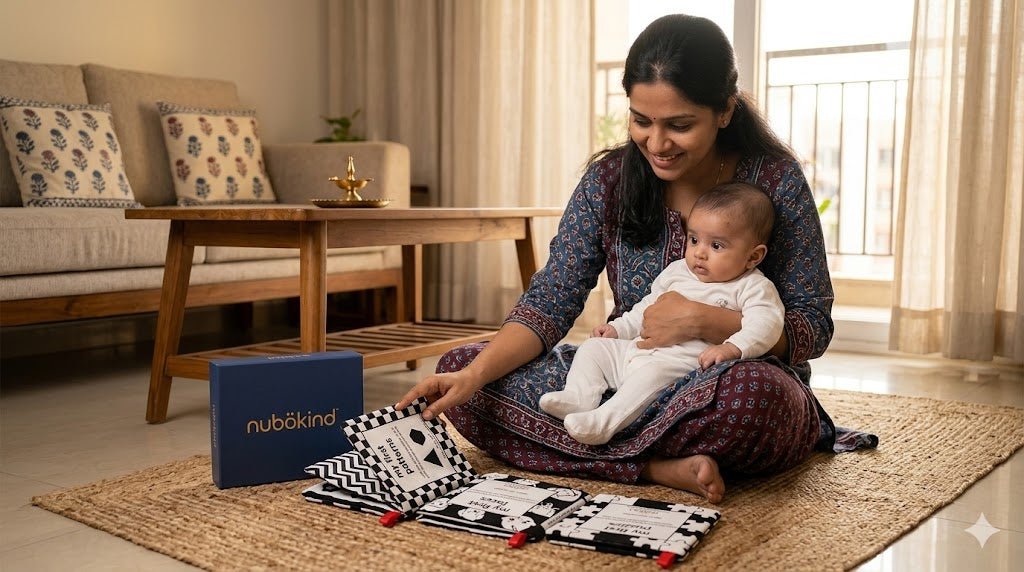
The linking ribbon included with the Nubokind flashcards allows you to create a hanging visual gallery — one of the most effective passive developmental tools available.
-
1Thread the ribbon through the card holes in the order you want to display them — geometric patterns first, then faces, then objects, matching your baby’s current stage.
-
2Hang at exactly 8–12 inches from where your baby’s face will be — measure this. On a crib, measure from the mattress up. On a play gym, measure from the floor or mat.
-
3Angle the cards slightly toward the baby — flat cards perpendicular to the line of sight are harder to see clearly. A slight tilt improves visual engagement.
-
4Rotate the gallery every 3–5 days — once a baby has processed a set of cards thoroughly, new images provide fresh neural stimulus. Novelty drives continued engagement.
-
5Use it on the stroller too — clip the ribbon across the stroller hood or handlebar at the correct distance. Consistent high-contrast stimulation during transit keeps the brain actively processing even when out of the home.
Quick Reference: Flashcard Usage by Month
- Week 1–4: Geometric B&W patterns · 8–12 inches · 3–5 min sessions · 1–3x daily · No tracking yet
- Month 1–2: Add slow left-right tracking · Introduce tummy time with card as visual target · Begin crib gallery
- Month 2–3: Add face cards · Narrate names · Alternate with your own face · Continue geometric cards
- Month 3–4: Add real-world object cards · Contextual timing (show Bottle before feeding) · Introduce bold primary colors
- Month 4–6: Full gallery sequences · Object recognition games (Where is the Bottle?) · Bonding narration sessions
Abstract geometric patterns → high-contrast faces → real-world labeled objects. 20 image sides. Linking ribbon included. High-GSM anti-glare matte finish. Safe from birth. Part of the Montessori Newborn Essentials Kit.
Frequently Asked Questions
The Flashcards Built for This Exact Progression
10 dual-sided cards. 20 image sides. Geometric patterns → faces → real-world objects. Linking ribbon for crib and play gym galleries. Anti-glare matte finish. Safe from birth. Part of the Montessori Newborn Essentials Kit.

leave a comment
This site is protected by hCaptcha and the hCaptcha Privacy Policy and Terms of Service apply.