
Why Montessori Toys for Newborns Are Fundamentally Different From Regular Baby Toys
Regular baby toys are designed to entertain — they use bright colors, flashing lights, and electronic sounds to capture a baby's attention. Montessori newborn toys are designed to develop — they provide carefully calibrated stimulus that matches the specific neurological stage of the baby. The difference is not aesthetic. It is neurological. During the first 6 months, the right tool at the right moment can trigger millions of new brain connections per day. The wrong tool — however visually appealing to an adult — provides minimal developmental signal.
The Core Montessori Principle for Newborns
Montessori education for newborns is built on one principle: give the right stimulus at the right developmental moment. Not earlier. Not later. Not louder or brighter. Just matched — precisely — to what the infant brain is ready to process.
This sounds simple. It is not. Most parents and even many toy manufacturers do not know that a newborn's brain processes visual information fundamentally differently from a three-month-old's brain, which processes it fundamentally differently again from a six-month-old's. Each stage has a specific neurological window — and a specific type of input that opens it most effectively.

What Regular Baby Toys Actually Do to the Developing Brain
Most baby toys sold in India and globally are built around one goal: capturing a baby's attention so the parent gets a break. This is entirely understandable — and there is nothing wrong with it. But it is important to understand what these toys are and are not doing for your baby's brain.
Newborns Cannot See Most Colors — So Colorful Toys Provide Weak Signal
- In the first 8 weeks, a baby's visual acuity is approximately 20/600. They primarily see black, white, and shades of grey.
- The cone cells responsible for color detection are not yet functioning effectively. A bright red toy looks to a newborn roughly as a pale, blurry shape — not the vivid stimulus the manufacturer intended.
- High-contrast black and white patterns, by contrast, provide the sharpest possible signal to the immature visual cortex — triggering significantly more neural connections per minute of exposure.
Overstimulation Is a Real and Measurable Risk
- The newborn nervous system is not designed for rapid, unpredictable sensory input. Flashing lights and electronic sounds can trigger a stress response — causing fussiness, overstimulation, and disengagement.
- Montessori practice prioritizes predictable, cause-and-effect sensory experiences — like a crinkle page that responds to the baby's own touch — over passive electronic stimulation.
- Cause-and-effect learning is one of the earliest and most important cognitive skills. A baby who crinkles a page and hears a sound is learning agency. A baby watching a screen flash is not.
Faces and Real-World Objects Build Cognitive Association — Cartoon Characters Do Not
- From month 3 onward, the infant brain begins building its first cognitive associations — linking visual patterns to objects, people, and concepts it recognizes from the real world.
- A flashcard showing "Mama" or "Bottle" activates the brain's association centers in ways a cartoon character simply cannot — because the baby has direct real-world experience with these objects.
- This is the neuroscience behind the "My World" philosophy of real-world object flashcards — and why the progression from abstract patterns to faces to everyday objects is sequenced deliberately, not randomly.
What Montessori Newborn Tools Actually Do — Stage by Stage
| Baby's Age | What the Brain Needs | Montessori Tool | What It Builds |
|---|---|---|---|
| 0–4 weeks | High-contrast B&W at 8–12 inches | Flashcards on crib ribbon | Visual cortex activation, optic nerve development |
| 1–2 months | Edge detection, bold geometric patterns | Cloth book geometric pages | Magnocellular pathway, shape recognition |
| 3 months | Tracking moving objects, first colors | Slowly moved flashcards | Smooth pursuit, binocular coordination |
| 4–5 months | Depth cues, things to reach for | Self-standing fold-out book | Stereopsis, intentional motor reach |
| 5–6 months | Real-world object recognition | Labeled real-world flashcards | Cognitive association, early language foundations |
The Four Pillars: What Montessori Newborn Development Actually Targets
Ocular Focus and Tracking
- High-contrast imagery activates more neural connections in the visual cortex than color-based alternatives during the first 8 weeks.
- Repeated exposure to high-contrast patterns builds visual fixation — the ability to hold focused gaze on a target.
- Slow tracking exercises develop smooth pursuit — the eye movement skill that later underpins reading.
Physical Milestones Through Motivated Movement
- A self-standing tummy time book gives a baby a visual target to lift their head toward — making tummy time intrinsically motivating rather than an uncomfortable exercise.
- Variable-height illustrations encourage multi-directional neck movement, building the core and shoulder strength essential for rolling, sitting, and crawling.
- Motivated movement is more effective than passive positioning because the baby's own effort drives the muscle development.
Multi-Sensory Neural Mapping
- The infant brain builds its map of the world by connecting inputs from multiple senses simultaneously — sight, touch, and sound processed together form stronger neural connections than any single sense alone.
- A crinkle page that responds to touch while displaying a visual pattern creates a multi-sensory learning moment. An electronic toy that plays a random sound does not.
- Baby-safe mirrors support self-recognition — one of the earliest social-cognitive milestones — and reinforce the connection between visual input and social identity.
Cognitive Recognition and Early Language
- Real-world object flashcards — Mama, Papa, Bottle, Crib — trigger the brain's association centers by connecting visual input to lived experience.
- Narrating cards during bonding time bridges the gap between sight and language comprehension, building early vocabulary foundations months before a baby can speak.
- Sequencing cards from abstract patterns → faces → everyday objects mirrors the brain's natural cognitive progression — each stage building on the last.
How to Identify a True Montessori Newborn Tool
Not everything labelled "Montessori" is actually engineered for development. Use this checklist.
- Stage-matched stimulus — the visual content matches what the baby's brain can actually process at their current age, not generic "baby" imagery
- High contrast for 0–8 weeks — true black and white, not grey-on-cream or soft pastels
- Real-world objects from month 3 — faces, familiar items, everyday scenes — not cartoon characters
- Cause-and-effect sensory elements — crinkle, squeak, mirror — that respond to the baby's own action
- No passive electronic stimulation — no sounds or lights that play without the baby initiating them
- Safe for mouthing — non-toxic, lead-free, phthalate-free, with no small parts or sharp edges
- Designed to be used, not displayed — functional in tummy time, crib, stroller, and play gym settings
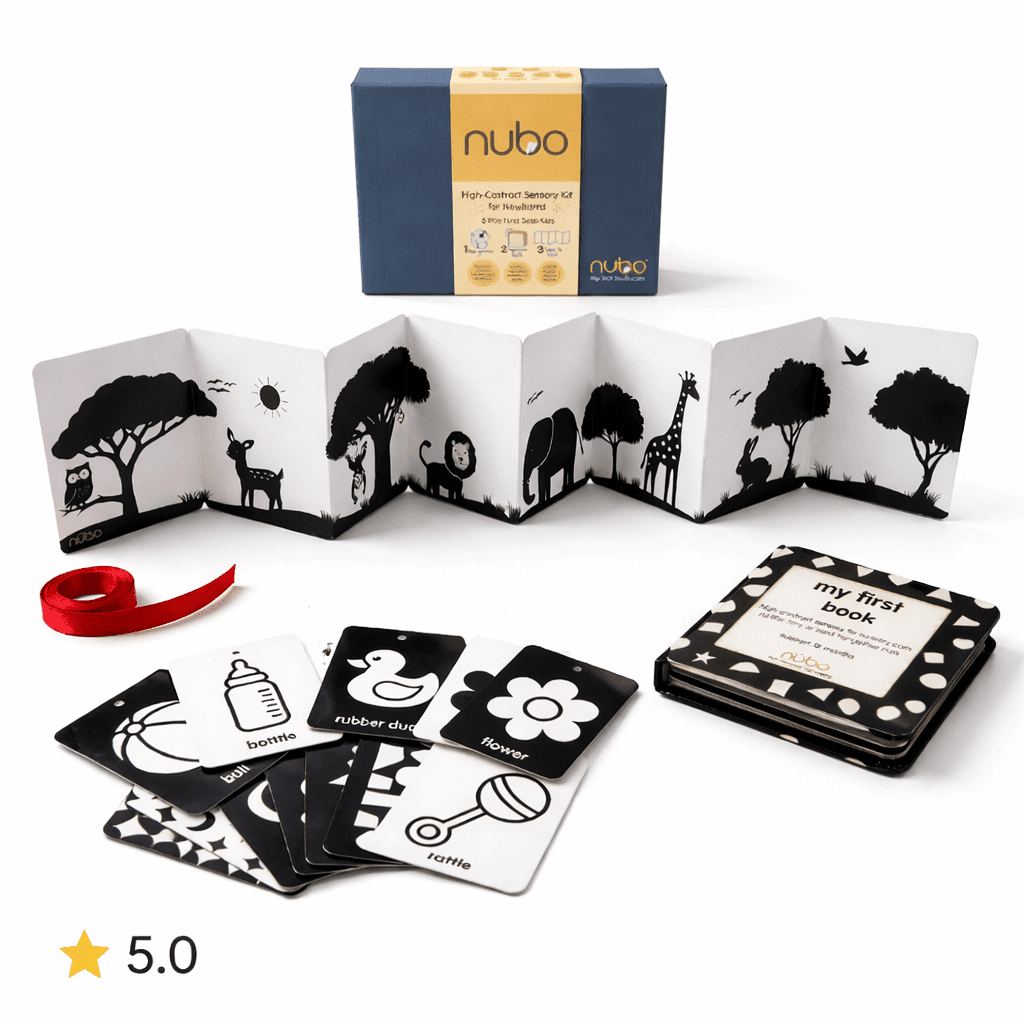
Three tools engineered around the neuroscience of the first 6 months — not the aesthetics of the nursery. Oxford-founder designed. Made in India. Free shipping nationwide.
Frequently Asked Questions
Montessori Is Not a Label. It Is a Method.
The Nubokind Montessori Newborn Essentials Kit is built around the neuroscience of the first 6 months — not the aesthetics of the nursery. Three tools. Four developmental pillars. Every milestone from birth.


leave a comment
This site is protected by hCaptcha and the hCaptcha Privacy Policy and Terms of Service apply.