
Best Newborn Cloth Books India 2026: Complete Buying Guide
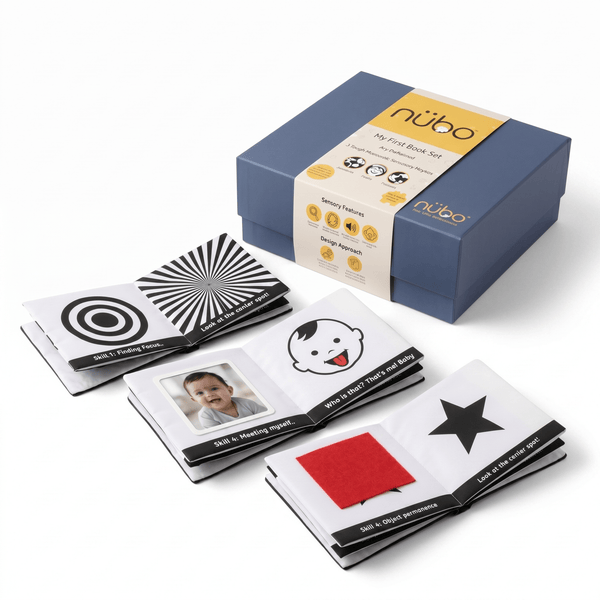
The best cloth book for a newborn in India combines high-contrast black-and-white pages for the 0–2 month stage, crinkle and colour pages for 2-4 months, and washable, non-toxic fabric for the mouthing stage from 4 months onward. If you are buying one, the Nubokind High-Contrast Cloth Book Set is the only Indian-made option built around all three stages.
Every baby product category in India has dozens of options that look similar on paper but deliver very different results in practice. Cloth books are no exception. There are imported options, budget options, and Indian-made options, and choosing between them without a clear framework means either overspending on something mediocre or underspending on something that does not actually do what a newborn needs.
This guide cuts through the noise. It covers exactly what makes a cloth book developmentally useful for a newborn, what safety standards matter in the Indian context, and which features are worth paying for versus which are just marketing. If you are trying to find the best newborn cloth book in India for 2026, this is the only guide you need.
What a Newborn Actually Needs From a Cloth Book
Before evaluating any specific product, it helps to understand what your baby can perceive at birth and how that changes over the first six months. This is the foundation for every buying decision.
A newborn's visual acuity at birth is approximately 20/400 — they can only clearly focus at 8 to 12 inches, and colour vision is absent for the first two months. The only images that register meaningfully are those with very bold, high-contrast edges. This is why a cloth book with pastel illustrations does nothing for a newborn's brain, regardless of how attractive it looks to adults.
0 to 2 months: Your newborn sees the world in soft blur at most distances. Clear focus exists only at 8 to 12 inches. Colour vision is essentially absent. What they do respond to strongly is high contrast — bold black-and-white edges, sharp geometric patterns, and simple face outlines. A cloth book that does not have strong high-contrast pages is not useful for a newborn. Full stop.
2 to 4 months: Colour vision begins developing, starting with red and bold primaries. Your baby starts tracking movement smoothly and reaches toward objects with increasing intention. A cloth book at this stage should have both high-contrast and colour pages, plus crinkle elements that reward reaching with sound.
4 to 6 months: Your baby grabs, mouths, and manipulates objects deliberately. The cloth book becomes an interactive sensory object. Materials must be safe for sustained mouthing — non-toxic dyes, no loose parts, fully washable.
A cloth book that serves all three stages is the most valuable purchase. One designed only for visual stimulation at birth will be outgrown in two months. The best infant cloth books grow with your baby through the full first half-year.
Safety Standards: What to Check Before Buying in India
India's Bureau of Indian Standards (BIS) covers toy safety under IS 9873. For cloth books and fabric toys in close contact with babies, the key safety considerations are:
- Non-toxic dyes and inks: The fabric and any printed patterns must use dyes that are safe for skin contact and mouthing. Check that the product explicitly states non-toxic or baby-safe colouring — not just that the outer fabric is cotton
- Colourfast dyes: Dyes that bleed when wet are a genuine concern for a product that will be regularly mouthed and washed. Test any new cloth book by dampening the fabric and checking for colour transfer
- No detachable parts: Buttons, plastic eyes, ribbon loops, or any embellishment that could detach and become a choking hazard are disqualifying features for babies under 12 months
- Fully washable: A cloth book that cannot be machine or hand-washed is not suitable for Indian conditions. Heat, humidity, and regular drooling mean washability is a hygiene requirement, not a luxury
Indian-made products with explicit BIS compliance or equivalent safety certification are preferable to imported items where the certification may not map to Indian standards.
Features That Actually Matter
High-Contrast Pages for the Newborn Stage
This is non-negotiable. The first cloth book you introduce to your baby must have pages that a newborn can actually see and respond to. Bold black-and-white patterns — stripes, checkerboard, radial designs, simple black-on-white faces — are what activate the developing visual cortex in the first two months. Pastel illustrations do nothing for a newborn's visual development regardless of how attractive they look to adults.
The Nubokind High-Contrast Cloth Book Set is built around this principle — each book in the set is designed for a specific developmental stage, with the earliest books featuring the bold patterns that newborn vision requires and later books introducing colour as the baby's visual system matures.
Crinkle Pages
From around six to eight weeks, crinkle pages add an auditory dimension to tummy time and floor play. When your baby swipes at a crinkle page and hears the sound, they are learning cause and effect — one of the earliest cognitive skills to emerge. Crinkle pages also make the cloth book useful as a tummy time toy because the sound rewards the physical effort of reaching during prone play.
A Mirror Panel
A baby-safe, unbreakable mirror panel is one of the most consistently engaging features in a cloth book for the two to four month stage. Babies at this age are fascinated by faces, and a mirror that reflects their own face holds attention during tummy time far longer than any static image. It also supports the self-recognition development that underpins social and emotional learning.
Varied Textures Across Pages
Smooth cotton, satin, soft felt, raised embroidery — different textures across pages build the somatosensory vocabulary that underpins fine motor development. When your baby touches a new texture, their brain is mapping what smooth versus rough, stiff versus soft feels like. A book with only one type of fabric across all pages misses this developmental opportunity entirely.
Size and Weight
A cloth book should be light enough for a baby to hold independently from around four to five months, and small enough to fit in a standard nappy bag for clinic visits, travel, and family outings. A book that is too large or too heavy will not be used consistently — and consistency is what determines whether the developmental investment pays off.
The Nubokind High-Contrast Cloth Book Set
For the Indian market in 2026, the Nubokind High-Contrast Cloth Book Set stands out as one of the most developmentally complete options available. The set includes three cloth books designed to progress with your baby across the 0 to 6 month window — high-contrast black-and-white pages for the newborn stage, bold colour pages as vision matures, and crinkle elements and varied textures for the tactile exploration stage.
Materials are baby-safe and washable, the books are sized correctly for floor tummy time as a propped visual anchor and for baby hands from four months onward, and the Indian brand context means the product is designed for Indian conditions rather than adapted from a Western market.
For parents building out a complete early sensory environment from birth, the High-Contrast Newborn Essentials Kit pairs the cloth book set with additional high-contrast flashcards and a fold-out visual mat — giving you a full toolkit of toys for newborn to 6 months that work together as a system rather than as individual items.
How to Use a Cloth Book From Day One
The best cloth book in India is useless if it sits on a shelf. Here is how to make it part of your daily routine from birth:
Week 1 to 4: Hold the book at 8 to 10 inches from your baby's face during alert windows. Choose the boldest high-contrast page. Say the names of what you see: "Stripes. Black and white." Two to three minutes is enough.
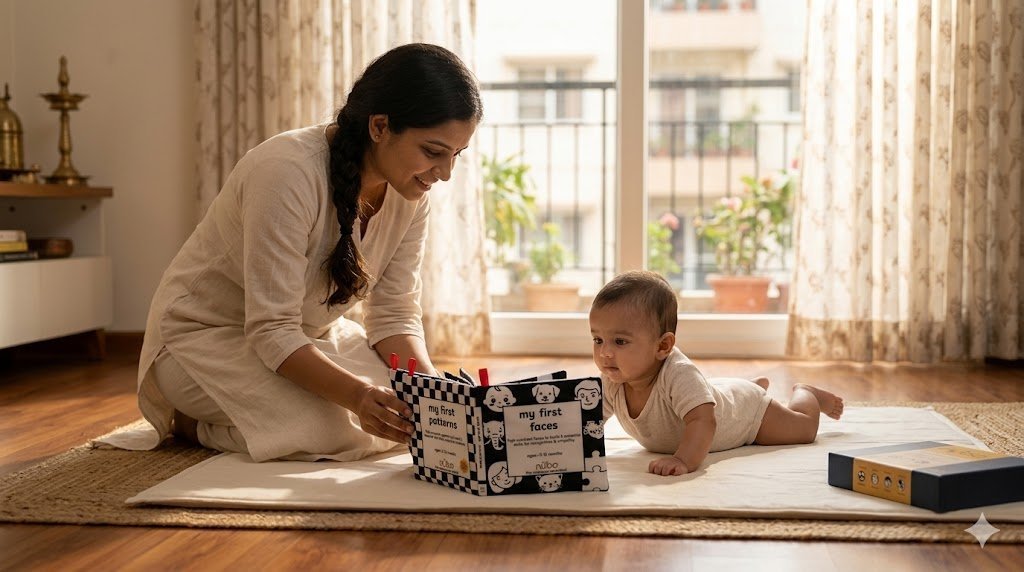
Month 1 to 3: Prop the book upright during tummy time for newborns on the floor. The visual motivation to look at the page drives head-lifting and neck strengthening. This is the most productive combination of cloth book and tummy time in the first three months.
Month 3 to 6: Let your baby hold the book during lap time, supervised floor play, and family interactions. Allow mouthing and crinkling. Narrate the pages with your family's language — Hindi, Tamil, Bengali, whatever is spoken at home. The repetition of words paired with images is the earliest foundation of vocabulary.
Frequently Asked Questions
What is the best cloth book for newborns in India in 2026?
The best cloth book for newborns in India in 2026 is one that combines high-contrast black-and-white pages for the 0 to 2 month stage, crinkle elements and colour pages for 2 to 4 months, and varied textures and washable baby-safe materials for the 4 to 6 month mouthing stage. The Nubokind High-Contrast Cloth Book Set is designed around exactly this developmental progression for the Indian market.
When should I introduce a cloth book to my newborn?
You can introduce a high-contrast cloth book to your newborn from the first week of life. Hold it at 8 to 10 inches from their face during alert windows and choose pages with bold black-and-white patterns. Newborns cannot focus beyond this range or perceive colour yet, but they respond strongly to high-contrast images, which actively stimulate the developing visual cortex.
Are cloth books safe for babies to chew in India?
A well-made cloth book with non-toxic, colourfast dyes, no detachable parts, and washable fabric is safe for mouthing from around four months when babies begin reaching for and chewing objects. Always check that the product explicitly states non-toxic baby-safe materials, and avoid any cloth book with buttons, plastic eyes, ribbon ties, or embellishments that could come loose.
Can I use cloth books during tummy time?
Yes — propping a cloth book upright at 8 to 10 inches in front of your newborn on tummy is one of the most effective tummy time setups. The high-contrast pages give your baby a visual reason to lift their head, which is the core developmental purpose of tummy time. Among tummy time toys and toys for newborn to 6 months, a high-contrast cloth book delivers more consistent developmental return during floor sessions than most other options.
What is the difference between a cloth book and a board book for newborns?
Cloth books are soft, flexible, and safe for mouthing — making them the correct choice for the 0 to 6 month stage when babies cannot yet handle the stiff pages of board books and will chew everything they touch. Board books are appropriate from around 12 months when a baby has the motor control to turn stiff pages and is past the intensive mouthing stage. For newborns and infants under six months, cloth books are the developmentally appropriate format.


1 comment
Link to but
Jyoti Gangwani
leave a comment
This site is protected by hCaptcha and the hCaptcha Privacy Policy and Terms of Service apply.