
How to Use a Cloth Book During Tummy Time: Step-by-Step Guide
Tummy time and a cloth book are both useful on their own. Together, they are something more: a daily routine that builds neck strength, stimulates vision, and turns floor time from something your baby tolerates into something they actively respond to.
Using a cloth book during tummy time for newborns is not complicated, but there is a right way and a less effective way to do it. The distance matters. The positioning matters. The choice of pages matters at different ages. This guide walks through exactly how to combine these two things at each stage of the 0 to 6 month window, so every tummy time session is doing its maximum developmental work.
Why Cloth Books Work So Well During Tummy Time
The reason a cloth book is one of the best tummy time toys comes down to newborn vision. A baby placed on their tummy has one job in terms of development: lift their head. But lifting your head when you are a few weeks old is hard, and without a compelling reason to do it, most babies simply will not bother — they will just fuss.
A high-contrast cloth book propped at the right distance gives your newborn on tummy a reason. Their visual cortex responds more powerfully to bold black-and-white patterns than to anything else in the first two months of life. When they see a high-contrast page at 8 to 12 inches, the instinct is to look at it more clearly — and looking more clearly means lifting their head. That lift is the entire point of the exercise.
This is why a cloth book is among the most developmentally efficient toys for newborn to 6 months. Unlike most items in that category, it actively motivates the specific physical action that tummy time is designed to produce, rather than just sitting nearby while the baby struggles.
How to Position the Cloth Book During Tummy Time
Positioning is where most parents go wrong. The most common mistake is placing the book too far away — propping it at 20 to 30 cm when it should be at 8 to 12 inches (roughly 20 to 30 cm is actually about right for older babies, but for a newborn it should be at the closer end, around 20 cm).
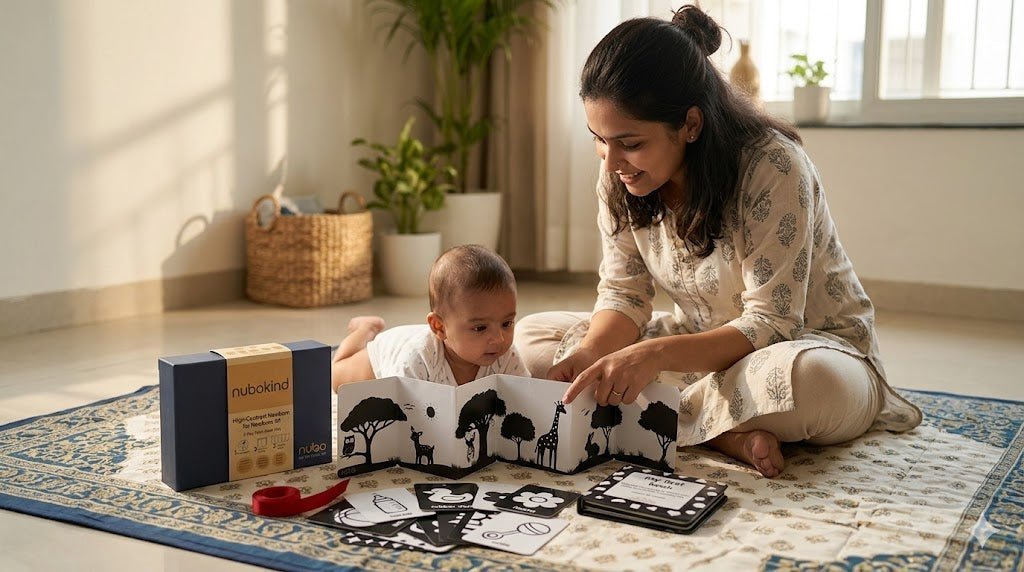
Here is the correct setup for floor tummy time with a cloth book:
- Place your baby face-down on a firm, flat surface — a cotton play mat or folded bedsheet on the floor
- Prop the cloth book upright directly in front of them, at 8 to 10 inches from their face
- The bottom edge of the book should rest on the mat — use the book's own spine to keep it standing, or lean it against a rolled towel
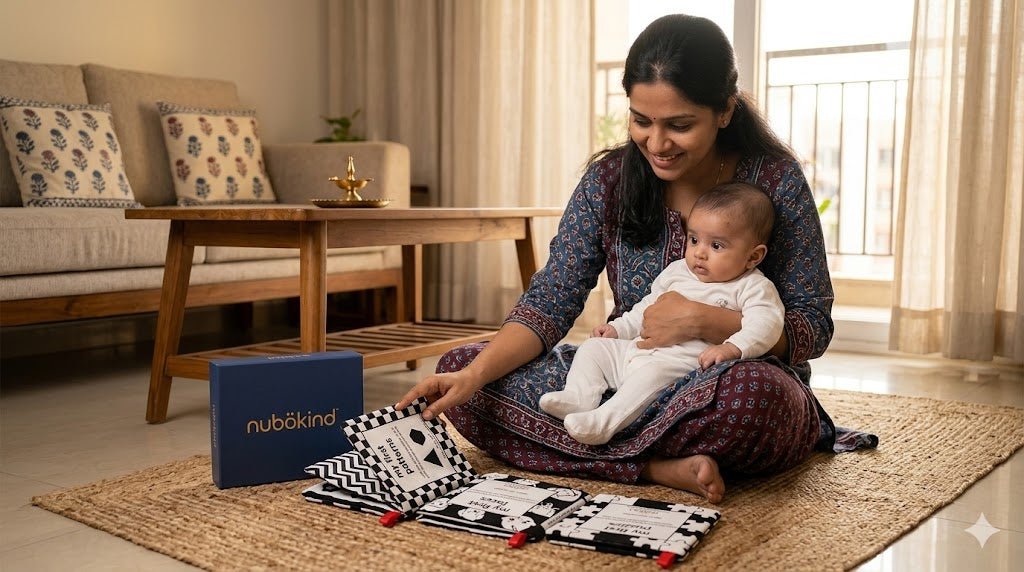
- Choose a high-contrast page for the 0 to 3 month stage — bold black-and-white patterns, simple faces, or geometric shapes
- Sit or kneel beside your baby so you are in their peripheral view, and narrate softly: "Look at the circles. Can you see the stripes?"
That is the entire setup. Simple, but the specifics — the distance, the page choice, being present — are what determine whether the session produces head lifts or immediate fussing.
Using a Cloth Book During Tummy Time: Age by Age
0 to 2 Months: Visual Anchor for Head Lifting
In the first two months, newborn and tummy time with a cloth book is entirely about motivation. Your baby cannot reach for the book or interact with it. They are simply looking at it, and that looking is prompting head lifts.
Choose the most high-contrast pages available — black-and-white stripes, bold checkerboard patterns, simple black-on-white face outlines. Hold or prop the book at 8 to 10 inches. Keep sessions to 2 to 3 minutes and watch for signs of fatigue: the head dropping back to the mat, face turning away, or escalating fussing. When you see these, end the session.
At this age, the book comes to the baby. You are placing it in front of them rather than expecting any interaction. That is correct — you are working with your baby's developmental level, not ahead of it.
2 to 4 Months: Tracking and Reaching
By two months, your baby can track a slowly moving object with their eyes. This opens up a new dimension for cloth book use during tummy time. Instead of just propping the book and watching, you can slowly move it a few inches to the left and right while your baby is on their tummy and watch their eyes follow.
This tracking movement during the prone position is doing double developmental work: strengthening neck muscles through the sustained head lift and building smooth eye tracking that supports reading readiness much later on. It is a small addition to the routine but genuinely valuable.
From around three months, your baby may begin swiping at the book with one hand while they are on their tummy. Encourage this. That swipe is the beginning of intentional reaching, and having the book close enough to bat at makes the tummy time session into a full sensory experience — visual, tactile, and auditory (the crinkle pages in the Nubokind High-Contrast Cloth Book Set produce a crinkle sound when touched, which adds an auditory reward to the reach).
4 to 6 Months: Grabbing, Mouthing, and Pivoting
By four months, tummy time with a cloth book becomes genuinely interactive. Your baby can now lift their chest off the floor on extended arms and reach forward deliberately. Place the cloth book just slightly beyond comfortable reach and watch them attempt to army-crawl toward it — pushing forward with their forearms to close the gap.
This forward reach during tummy time for newborns approaching the older end of the range is one of the most important physical progressions that happens before crawling. The cloth book gives your baby a target to move toward, turning passive tummy time into active locomotion practice.
At this age they will grab the book, pull it toward them, and bring it straight to their mouth. This is completely expected. The High-Contrast Newborn Essentials Kit is made from baby-safe, washable materials specifically because mouthing is a normal part of how babies at this stage explore objects. Let it happen.
Common Mistakes to Avoid
Placing the book too far away: Beyond 12 inches, a newborn cannot see the pages clearly enough to be motivated by them. The book needs to be close.
Using a colourful book with a very young baby: Pastel or brightly coloured pages do not register as strongly as high-contrast black-and-white for babies under two months. Save the colourful pages for the 3 to 6 month stage when colour vision is established.
Leaving the baby unsupervised: A newborn on tummy must always be supervised. Tummy time is never a sleep position, and even with a book in front of them a baby can tire suddenly and not have the strength to turn their head.
Doing it immediately after a feed: A full stomach in the prone position causes discomfort and spitting up. Always wait at least 20 to 30 minutes after a feed before a floor tummy time session.
Frequently Asked Questions
How do I use a cloth book during tummy time with a newborn?
Prop the cloth book upright at 8 to 10 inches in front of your newborn on tummy on a firm floor mat. Choose a high-contrast black-and-white page. Sit beside your baby, narrate softly, and let the visual stimulus motivate them to lift their head toward the book. Keep sessions to 2 to 3 minutes in the first month and build up gradually as your baby's neck strength increases.
At what age can I start using a cloth book during tummy time?
You can use a cloth book as a visual anchor during tummy time from the first week of life, as soon as your baby is having supervised floor sessions. Prop it at 8 to 10 inches in front of them and choose the boldest high-contrast pages. Before floor tummy time begins, chest-to-chest tummy time is the better starting point — introduce the cloth book once your baby is comfortable spending short periods on the floor.
Why is a cloth book one of the best tummy time toys?
A cloth book is one of the best tummy time toys because it actively motivates the specific physical action that tummy time is designed to produce — lifting the head. The high-contrast pages trigger visual attention in newborns, and attention motivates head lifts. Most other toys for newborn to 6 months do not provide this direct connection between visual stimulus and physical effort during tummy time.
What should I look for in a cloth book for tummy time?
Look for a cloth book with high-contrast black-and-white pages for the newborn stage, a stable spine that allows it to stand upright without support, crinkle elements for auditory stimulation from two months onward, and washable, non-toxic materials safe for mouthing. Size matters too — the book should be large enough to be visible at 8 to 10 inches but not so heavy that it tips over easily on a mat.
How does newborn and tummy time with a cloth book support development?
Newborn and tummy time with a cloth book supports development across multiple domains simultaneously: neck and shoulder strength from the physical effort of head lifting, visual cortex development from the high-contrast stimulation, eye tracking from watching the book move, sensory exploration from the textures and crinkle sounds, and early language development from the caregiver narrating the pages. Few other tummy time activities deliver this range of developmental benefit in a single session.

leave a comment
This site is protected by hCaptcha and the hCaptcha Privacy Policy and Terms of Service apply.