
5 Benefits of Cloth Books in the First 3 Months (Backed by Science)
Parents buying a cloth book for a newborn are often told it is good for development. What they are rarely told is why — specifically, which systems in the brain and body are being activated, what the research actually says, and why the first three months in particular are such a significant window for this kind of stimulation.
Here are five concrete, research-backed benefits of using cloth books in the first three months of your baby's life. These are not general claims about learning or bonding — they are specific developmental outcomes tied to specific features of infant cloth books and how they interact with your baby's biology at this stage.
Benefit 1: Visual Cortex Development Through High-Contrast Stimulation
At birth, your baby's visual cortex — the region of the brain responsible for processing what the eyes see — is among the least developed areas in the entire nervous system. It is not broken or incomplete; it is simply waiting for the input it needs to wire itself up. That input is contrast.
Newborns are most sensitive to edges and contrast — sharp transitions between light and dark. Bold black-and-white patterns, geometric shapes, and simple face outlines activate more neurons in the visual cortex than any coloured image can in the first two months, because colour vision requires a level of cone cell maturity that simply does not exist yet at birth.
Every time a newborn fixates on a high-contrast page, visual neurons fire and form synaptic connections. The more frequently those connections are activated, the stronger and more efficient they become. This is not metaphorical — it is the literal mechanism by which early visual experience determines the quality of long-term visual processing.
A high-contrast infant cloth book held at 8 to 10 inches during alert windows — during tummy time, during a feed pause, during a quiet awake period — is delivering exactly the input the visual cortex is actively seeking in these first weeks. A pastel-illustrated book at this stage is largely wasted on a system that cannot process it yet.
Benefit 2: Neck and Shoulder Strength Through Tummy Time Motivation
The connection between cloth books and physical development is direct and practical. Tummy time for newborns is one of the most important physical habits of the first six months, but it only produces results if your baby actually lifts their head — and most babies will not lift their heads without a compelling reason to do so.
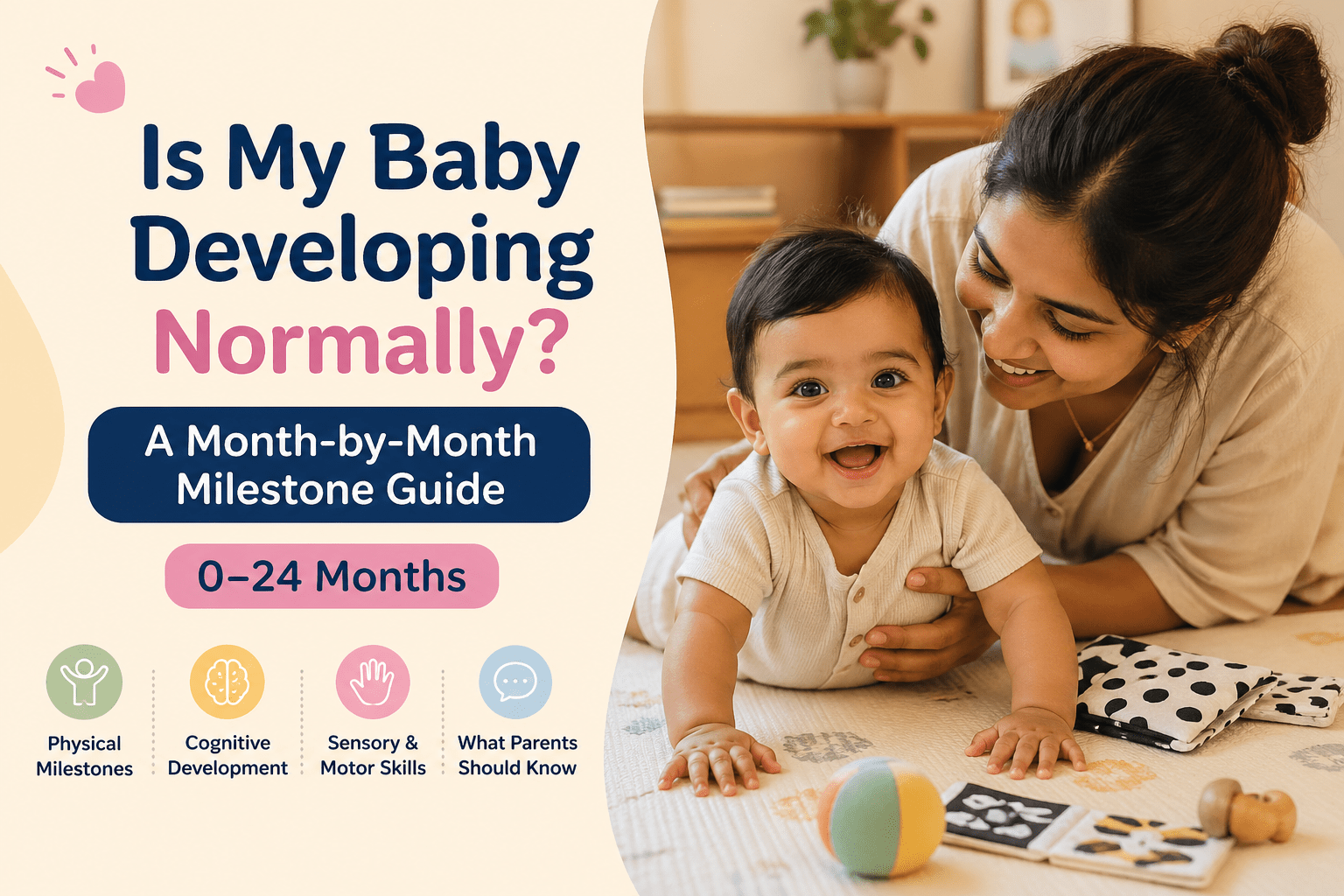
Placing a high-contrast cloth book upright in front of a newborn on tummy provides that reason. The visual stimulus motivates the head lift, and the head lift is what builds the neck, shoulder, and upper back muscles that underpin every subsequent gross motor milestone: holding the head steady, sitting independently, crawling, standing.
In this sense, a cloth book is not just a visual toy — it is an indirect physical therapy tool. Used consistently during newborn and tummy time floor sessions from the first month, it turns what would otherwise be a frustrating and short-lived exercise into a purposeful activity your baby has a reason to persist with. Among all tummy time toys, this is the most direct mechanism connecting a toy to a physical outcome.
Benefit 3: Early Language Foundations Through Caregiver Narration
Language development does not begin when a baby says their first word. It begins in the first weeks of life, through the accumulation of auditory input that the brain stores and begins categorising long before speech is possible.
When you sit with your baby and narrate a cloth book — "This is a circle. Black and white. Round and round" — you are doing several things simultaneously. You are exposing your baby's auditory cortex to the phonemes of your language, helping the brain distinguish between the sounds that matter and those that do not. You are pairing words with visual objects, building the earliest vocabulary associations. And you are creating a shared attention loop — you look at the book, your baby looks at the book, you name what is there — which is one of the fundamental mechanisms of language acquisition.
Importantly, this works in any language. Hindi, Tamil, Telugu, Marathi, Bengali — narrating a cloth book in your mother tongue during the first three months is not a lesser version of reading in English. It is precisely the right linguistic environment for your baby's brain, which is calibrating itself to the language it will actually need.
The Nubokind High-Contrast Cloth Book Set gives Indian families a book that can be narrated in whatever language is spoken at home, with images simple enough that the narration does not need to be elaborate — a single word per page is perfectly effective at this stage.
Benefit 4: Sensory Integration Through Texture, Sound, and Visual Input Together
From around six to eight weeks, your baby begins reaching toward objects with increasing intent. By three months, many babies can bat at something in front of them and are beginning to understand that their hands can interact with the world. This is the stage where infant cloth books with crinkle pages and varied textures become important.
When a baby swipes at a crinkle page and hears the sound, they are experiencing sensory integration — the brain's process of combining input from multiple senses into a single coherent experience. Vision, touch, and hearing are being processed simultaneously and linked together. The brain records: "When I touch this specific thing, this sound happens." That is cause and effect. That is the cognitive foundation of problem-solving.
Varied textures — smooth cotton, satin, soft felt, slightly raised embroidery — give the somatosensory cortex (the brain's touch-processing region) a rich vocabulary to build from. Each new texture is mapped, stored, and compared to what has come before. This is not trivial stimulation: it is the sensory input that underpins fine motor development and hand sensitivity well into toddlerhood.
Among toys for newborn to 6 months, few items deliver this breadth of multi-sensory input in a single object. The cloth book is unusual in combining visual, tactile, and auditory stimulation without any electronic component or battery — passive, endlessly reusable, and safe from birth.
Benefit 5: Emotional Security and Attachment Through Shared Attention
The developmental benefits of cloth books are not purely cognitive and physical. There is a relational dimension that is equally important and often overlooked.
When you and your baby look at a cloth book together, you are engaging in what developmental psychologists call joint attention — both of you focused on the same object, with awareness of each other's attention. This is one of the earliest and most significant social-cognitive milestones. It is a prerequisite for language, for empathy, and for the secure attachment that shapes a child's emotional development across their entire life.
In Indian families, this shared attention can involve multiple caregivers — dadi, nani, an older sibling, a father who takes the book during an evening feed, a grandfather who narrates a page before the morning oil massage. Each of these interactions is a repetition of the joint attention loop, with a different voice and a different face, and each one is contributing to your baby's social-emotional development in a way that a solo interaction never can.
The High-Contrast Newborn Essentials Kit is designed to be used by multiple caregivers — the items are intuitive enough that grandparents and extended family can engage with them naturally, without instruction, making every moment with the baby a potential developmental interaction rather than just a holding exercise.
The First Three Months Are Different
It is worth naming why this window is specifically significant. Developmental neuroscience identifies the first three months of life as part of a broader sensitive period — a window during which the brain is uniquely receptive to certain categories of experience, and during which the absence of that experience has a greater impact than it would at any later time.
This does not mean that missing cloth book time in month one causes lasting damage. It means that the input provided during this window has an outsized effect on the strength of the neural architecture being built. A baby who has had consistent high-contrast visual stimulation, regular tummy time with a cloth book, and daily narration from caregivers is entering month four with a meaningfully richer sensory foundation than one who has not.
Cloth books are not magic. But used consistently, from the first weeks, in the ways described here, they are one of the simplest and most evidence-aligned tools available to Indian parents who want to support their baby's development without complicated equipment, expensive gadgets, or screen-based solutions.
Frequently Asked Questions
Do cloth books really help with newborn development?
Yes. High-contrast infant cloth books actively stimulate the visual cortex during the critical 0 to 3 month window when newborn vision is developing. Used during tummy time, they motivate head lifting that builds neck and shoulder strength. With caregiver narration, they support early language foundations. And their varied textures and crinkle elements support sensory integration from around six to eight weeks. These are specific, documented developmental outcomes, not general claims.
How early can I use a cloth book with my newborn?
From the first week of life. A high-contrast cloth book held at 8 to 10 inches during your newborn's alert windows is providing exactly the visual input the developing visual cortex is seeking. You do not need to wait for any milestone. Keep sessions short — 2 to 3 minutes — and choose the boldest high-contrast pages available in the book.
Why are high-contrast cloth books better for newborns than colourful ones?
Newborn colour vision is essentially absent for the first two months of life. The visual cortex at this stage responds most powerfully to high contrast — sharp edges, bold black-and-white patterns, and simple geometric shapes. Colourful pastel books are not harmful, but they are not providing the visual stimulus that a newborn's brain is most equipped to process and benefit from. High-contrast infant cloth books are designed around newborn visual biology, not adult aesthetic preferences.
What is the connection between infant cloth books and tummy time?
A high-contrast cloth book propped upright in front of a newborn on tummy gives your baby a visual reason to lift their head — which is the core developmental purpose of tummy time for newborns. Without a visual anchor, many babies simply fuss and drop their head. With a bold cloth book at the right distance, the same babies will lift and hold their head to look at the page. The cloth book is one of the most effective tummy time toys precisely because it makes the physical effort feel purposeful.
Are cloth books among the best toys for newborn to 6 months?
Among toys for newborn to 6 months, high-contrast cloth books are consistently among the highest developmental value options because they remain relevant across the entire first six months. They are used for visual stimulation from birth, tracking from two months, reaching and crinkle exploration from three to four months, and page-turning interaction from five to six months. Few other items in this category deliver equivalent developmental return across the full window without being outgrown in the first few months.


leave a comment
This site is protected by hCaptcha and the hCaptcha Privacy Policy and Terms of Service apply.