
You've seen the black-and-white flashcards everywhere, but do they really do more than just grab your baby's attention? The answer is yes—when used intentionally for language building. Here's how high-contrast flashcards become a bilingual learning tool that grows with your child.
The Parent's Dilemma: Beautiful Toys That Don't Do Much
You walk into a store (or scroll through an app) and see them: stunning high-contrast flashcards with bold black-and-white patterns. The packaging promises "visual development" and "early learning." You buy a set thinking it'll keep your newborn engaged during tummy time for newborn sessions.
Then comes the moment of truth. Your baby looks at the card for three seconds, then looks away. You're left wondering: Is this actually doing anything? Or is it just a pretty distraction while I scroll through my phone?
Why Parents Feel Stuck With One-Dimensional Tools
Most parents don't realize that high-contrast flashcards aren't meant to be a one-phase toy. The cards you buy for your 2-month-old can evolve into a bilingual teaching tool for your 18-month-old. The problem? Parents aren't told how to make this transition, so the flashcards end up in a cupboard by month 4.
Here's what happens when you know the full potential: those same cards become anchors for language learning in both English and your native language—whether that's Hindi, Marathi, Tamil, or any other language spoken in your home.
How Infant Visual Development Sets the Stage for Language
Let's zoom into what's actually happening in your baby's brain. Newborns see only in fuzzy shapes until around 2 months old. Their vision is strengthened by high-contrast images—the sharper the black-and-white contrast, the harder their developing eyes work to focus.
This isn't just about vision, though. When your baby focuses on a high-contrast image, neural pathways are firing. The brain is learning to track movement, distinguish patterns, and associate visual information with meaning. By 4–6 months, your baby's eyes are stronger, their focus is sharper, and they're ready for the next layer: connecting what they see to words.
This is where bilingual development enters. Research shows that babies raised in multilingual homes activate the same neural pathways for both languages simultaneously. If you introduce labels in both English and your home language during this critical window, your baby's brain treats both as equally valid communication systems.
The Three Phases of High-Contrast Flashcards: From Newborn to Toddler
Understanding how high-contrast flashcards evolve makes all the difference. Here's how the same tool serves different developmental needs:
| Phase | Age Range | How Baby Engages | Language Connection |
|---|---|---|---|
| Phase 1: Visual Tracking | 0–3 months | Stares at patterns; follows moving card with eyes | Brain builds visual pathways; no language yet |
| Phase 2: Pattern Recognition + Sound Association | 4–8 months | Looks at card while you name it aloud in both languages | Baby hears "बॉल" and "ball" together while seeing shape; both words map to same object |
| Phase 3: Active Labeling & Vocabulary Building | 9–24 months | Points, vocalizes, attempts to say the word; plays with real object matching card | Baby actively builds vocabulary in both languages; understands both labels refer to same thing |
The breakthrough moment usually happens around 6–8 months, when your baby first realizes: "Oh, that image + this sound = that thing in my hand." This is when a simple tummy time toy becomes a language-learning powerhouse.
Practical Ways to Use High-Contrast Cards for Bilingual Learning
Here's how to move beyond just showing cards. These strategies work whether you're teaching English-Hindi, English-Tamil, English-Marathi, or any other language combination:
1. Pair the Card with Real Objects
Show the flashcard labeled "चम्मच" (spoon) and "Spoon," then place an actual spoon in your baby's hand. Say both words again while your baby explores. This multi-sensory approach—seeing the image, hearing both words, touching the real object—creates a much stronger neural connection than vision alone.
2. Use Repetition During Routine Moments
During tummy time activities, as your baby looks at the card, you narrate: "Look at the ball! It's a गेंद (gend)! Can you see the ball?" Natural, conversational exposure is more powerful than flashcard drills. Your baby absorbs both languages through everyday context.
3. Point and Let Your Baby Lead
By 10–12 months, your baby will start pointing at things they see or want. When they point at a sock or a spoon, immediately show them the corresponding card in both languages. You're validating their curiosity while building vocabulary.
4. Create a "Bilingual Wall" in Your Home
Laminate or frame your favorite high-contrast flashcards and hang them at eye level in your baby's play area. Throughout the day, as you pass by with your baby, casually name the images in both languages. Over time, these become familiar anchors in your home environment.
5. Transition to Cloth Books as Your Baby Grows
Around 6–8 months, when your baby develops better motor control, introduce cloth books for infants that incorporate high-contrast images. These allow more independent exploration and are less likely to be chewed to shreds than paper cards.
Why Montessori Principles Matter Here
Montessori education emphasizes sensory exploration and self-directed learning. The idea isn't to force your baby to memorize words, but to create an environment where language learning happens naturally.
When you use Montessori teaching toys like high-contrast cards, you're giving your baby autonomy. You show the card, name it in both languages, then let your baby decide if they want to explore it further. No pressure. No drilling. Just rich, bilingual input in a play-based context.
This approach aligns perfectly with how babies actually learn languages in multilingual homes—by hearing and seeing both languages used naturally and repeatedly in their environment.
Introducing Nubokind's High-Contrast Learning Tools
We created the High-Contrast Cloth Book Set and the Newborn Gift Kit with exactly this philosophy in mind. These aren't just pretty tools—they're designed to grow with your child from newborn through toddlerhood.
Each product includes simple icons and bilingual labels (in English and major Indian languages), so you can use them naturally in the three phases we discussed. The cloth books are soft enough for gums during tummy time for newborn sessions, yet durable enough to handle months of exploration. High-contrast patterns are specifically chosen for infant visual development, and the simplicity of each image makes bilingual labeling easy and natural.
Parents tell us that once they understand how to use these tools across phases, the cards and books become some of their most-used items. What started as a tummy time book becomes a vocabulary-building companion that lasts well into the second year.
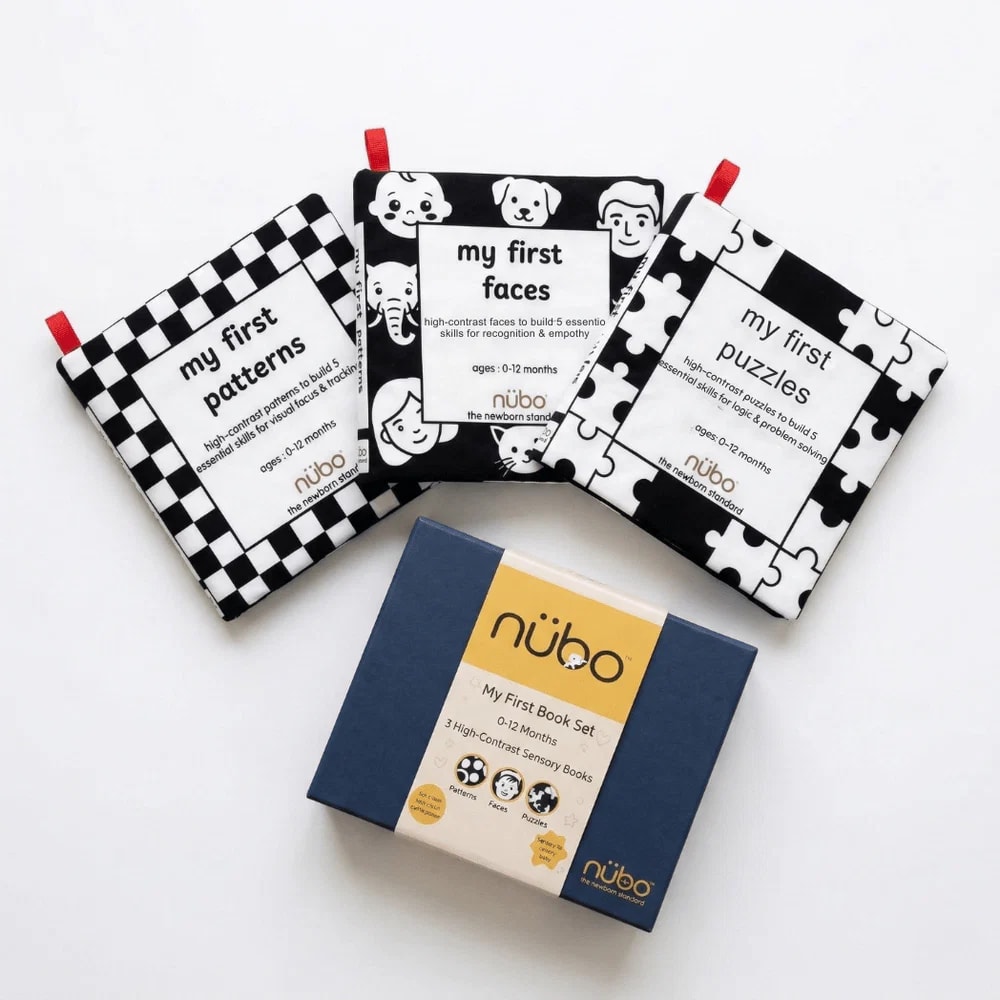
High Contrast Cloth Book Set
BIS Certified | High-contrast images | Soft, chewable pages | Birth to 18 months
₹699
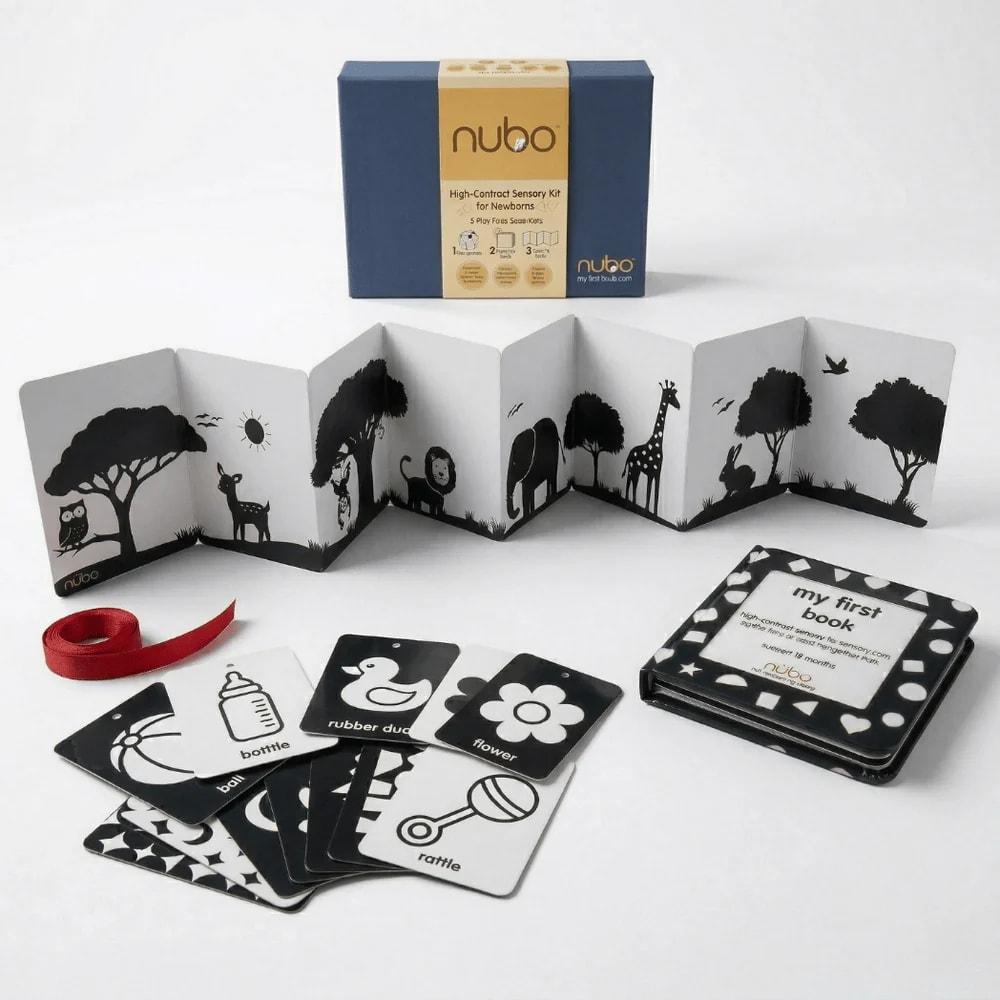
Newborn Gift Kit
BIS Certified | Montessori-inspired | High-contrast cards + cloth book + sensory elements | Birth to 12 months
₹699
What Other Parents Are Saying
Kumari Adarsha
Totally worth it
My daughter is just 1.5 months old , and I'm using this flashcards and cloth book for her tummy time and it is a perfect product for newborn.
Ujjwal
best quality
All the products in the kitare safe and of best quality, my baby loved it ❤️
FREQUENTLY ASKED QUESTIONS
Q: At what age should I start using high-contrast flashcards?
A: You can introduce them as early as 2 weeks old, though your newborn will simply stare without much focus. The real benefit kicks in from 6–8 weeks onward, when babies can track movement and distinguish high-contrast patterns. That said, using them early primes your baby's visual system, so starting young doesn't hurt—it's never wasted effort.
Q: How often should I show the cards for language learning to stick?
A: Consistency matters more than duration. Showing cards 3–5 times a week for 2–3 minutes, paired with real objects and natural conversation, is far more effective than an intense 20-minute session once a month. Babies learn through repeated, playful exposure in everyday contexts. Aim for casual, daily integration rather than formal flashcard "lessons."
Q: Will using bilingual flashcards confuse my baby or delay language development?
A: No. Research consistently shows that bilingual exposure does not delay development. In fact, children raised bilingually often show cognitive advantages in areas like executive function and attention switching. By pairing both languages with the same image, you're actually helping your baby understand that one concept can have two labels—a sophisticated cognitive skill.
Q: Are high-contrast cloth books safer than paper flashcards for teething babies?
A: Yes, absolutely. Cloth books are soft, washable, and designed to be chewed safely. Paper flashcards can tear and become choking hazards. If your baby is in the teething phase (usually 4+ months), cloth books are the better choice. The visual benefits remain the same, but safety is much higher.
Q: How long do high-contrast flashcards remain effective for learning?
A: For visual development alone, their impact peaks around 6–8 months. But for language building, they're useful well into the second year—some children benefit from simple flashcards until 24 months. The key is evolution: as your child grows, you shift from passive viewing to active pointing, naming, and object matching. Montessori educational toys work best when they adapt to your child's changing abilities.
Q: Can I make my own high-contrast flashcards, or is there a reason to buy a complete set?
A: You can absolutely make your own, but there's value in a thoughtfully designed set. Commercial high-contrast cards are researched for optimal contrast ratios and designed for safe handling by babies. They also include bilingual labels if you choose sets like those from Nubokind, saving you the effort of adding labels yourself. If you're organized and patient, DIY works—but a ready-made set saves time and ensures developmental appropriateness.
CONCLUSION
High-contrast flashcards aren't a one-phase toy—they're a bridge between your baby's visual development and language learning. When you understand the three phases and commit to pairing cards with real objects and bilingual narration, something shifts. Those black-and-white patterns become anchors for vocabulary in two languages, and your baby's brain builds richer neural networks for both.
The best part? You don't need to overthink it. Show the card, say both words, let your baby explore. Repeat naturally throughout your day. Over weeks and months, you'll notice your baby recognizing objects, pointing, and attempting both labels. That's bilingual development in action.
If you're ready to move beyond generic flashcards to tools designed for this exact purpose, explore Nubokind's High-Contrast Cloth Book Set or the Newborn Gift Kit. Both are built on Montessori principles and designed to grow with your child through those critical early language-learning months.
Your baby's brain is ready to learn. The right tools just make the journey a little easier.


leave a comment
This site is protected by hCaptcha and the hCaptcha Privacy Policy and Terms of Service apply.