
Tummy Time for Newborns: When to Start and How Long Each Session Should Be
You are home from the hospital with a newborn who weighs less than a bag of rice, and someone — your paediatrician, a parenting app, a well-meaning relative — has told you to start tummy time. Your first question is reasonable: when, exactly? Your second question is equally reasonable: how long is long enough?
Here are the direct answers, because this is exactly the kind of question that deserves a straight response before all the context.
Start tummy time for your newborn from day one — or as soon as you are home and settled. There is no minimum age requirement, no milestone to wait for. The first session can happen in the first week of life, beginning with the gentlest form: your baby lying face-down on your chest while you recline.
For duration: begin with 2 to 3 minutes per session, two to three times a day. Build slowly toward 30 cumulative minutes per day by the time your baby reaches three months. That 30-minute target sounds significant, but spread across the day in short sessions, it is very achievable.
Why Starting Early Matters for Infant Tummy Time
The timing is not arbitrary. Infant tummy time begun in the first two weeks of life creates a habit before your baby has opinions about it. Newborns at one and two weeks old do not yet have the awareness to resist a position — they simply experience it. By the time they are six to eight weeks old and have begun to register preferences, tummy time already feels familiar rather than strange.
Babies who start tummy time at three months or later — often because parents were unsure when to begin — are typically more resistant because the prone position is genuinely unfamiliar by that point. The fussing and crying that many parents associate with tummy time is usually a product of delayed introduction, not an inherent problem with the position itself.
Starting early also means stronger neck muscles arrive earlier. Every day of tummy time is a day of incremental strength-building. Babies who have been doing it consistently from birth typically achieve head control milestones noticeably ahead of those who started later.
A Month-by-Month Duration Guide
Week 1 to Week 4: Chest-to-Chest, 2 to 3 Minutes
In the very first weeks, tummy time does not need to happen on the floor. Place your newborn face-down on your chest while you recline at a 45-degree angle on the sofa or bed. This is a fully valid prone position. Your baby's neck muscles are working against gravity, their vestibular system is engaged, and they are receiving all the developmental input without the cold unfamiliarity of a mat.
Keep these sessions to 2 to 3 minutes. Watch for signs that your baby has had enough: crying that escalates quickly, face pressing hard into your chest, or going limp. When you see these, end the session and comfort your baby. You are building tolerance gradually, not pushing through distress.
1 to 2 Months: Moving to the Floor, 3 to 5 Minutes
By four to six weeks, your baby will have slightly more neck strength and will be ready for short floor sessions. Place them on a firm, flat surface — a folded cotton bedsheet or a firm play mat on the floor. Kneel or sit in front of them so your face is at their level.
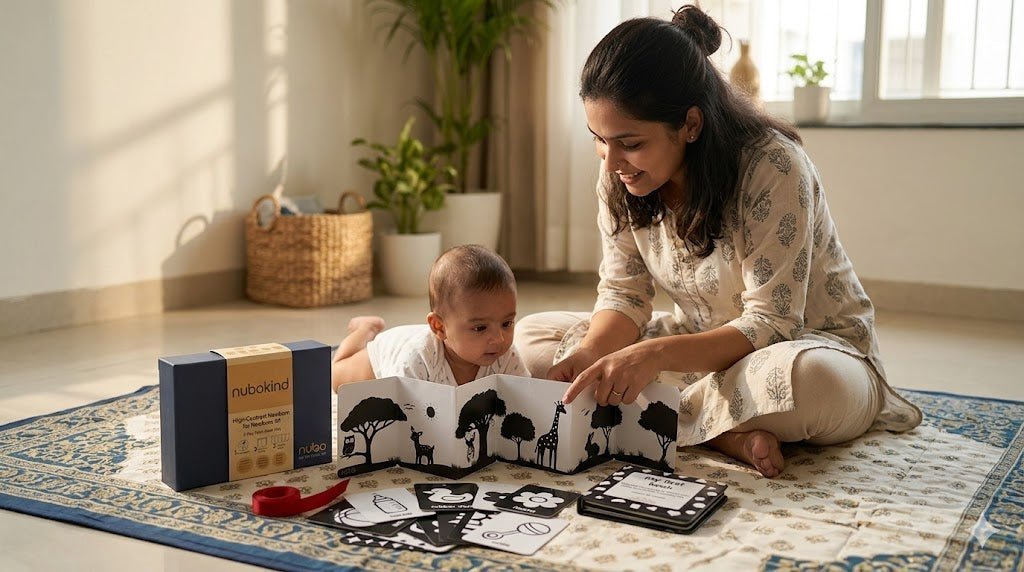
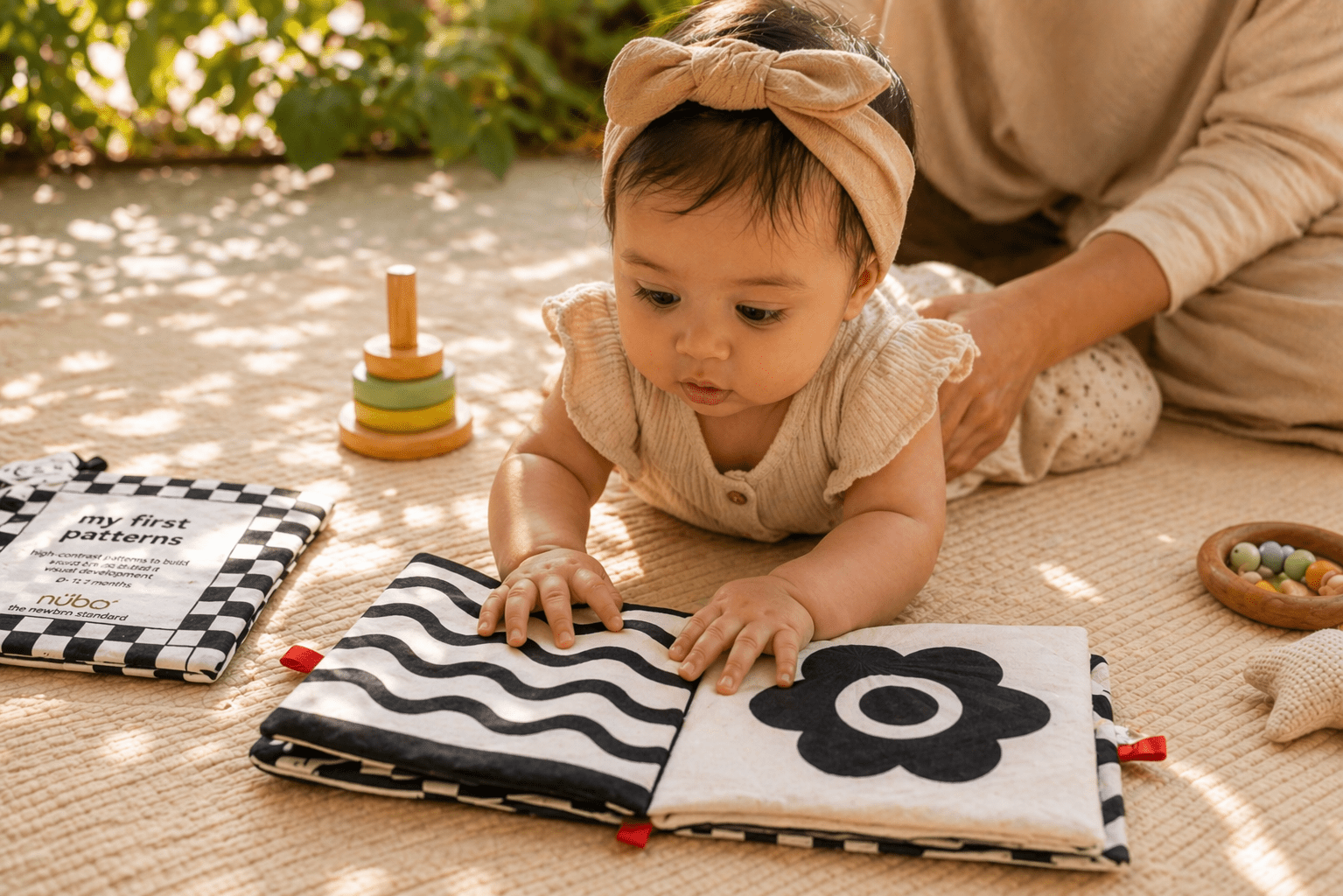
At this age, a high-contrast visual anchor makes a meaningful difference. Propping the Nubokind High-Contrast Cloth Book Set upright in front of your baby gives them something visually interesting to look at, which motivates head-lifting in a way that an empty floor does not. The bold black-and-white pages are exactly the kind of visual stimulus a one-to-two-month-old's developing visual cortex responds to most strongly.
Aim for 3 to 5 minutes per session, working toward 4 to 5 sessions across the day.
2 to 4 Months: Building to 10 Minutes
By two months, your baby can lift their head to roughly 45 degrees and hold it there briefly. By three months, many babies can reach 90 degrees. Sessions can now extend to 5 to 10 minutes, and your cumulative daily target should be reaching 30 minutes.
This is the stage where tummy time starts to look more like play. Your baby will begin tracking objects with their eyes during floor sessions, batting at things in front of them, and making deliberate attempts to turn their head toward sounds and faces. The High-Contrast Newborn Essentials Kit pairs well here — the flashcards alongside the cloth book give you more visual variety to keep sessions interesting as your baby's attention span grows.
4 to 6 Months: Working Toward 20-Minute Sessions
By four months, many babies who have been doing consistent tummy time will begin pushing up onto their forearms — lifting their chest off the floor. This is the mini push-up position that directly precedes crawling. Sessions of 10 to 20 minutes are appropriate at this stage, and most babies at this age begin to enjoy floor time rather than resist it.
How to Know Your Baby Has Had Enough
There is a difference between the brief fussiness that comes from mild discomfort and the genuine distress that signals a session should end. Look for:
- Face pressing flat into the mat with no attempt to lift
- Crying that escalates rather than settles within 30 seconds
- Body going limp or arching backward
- Sustained turning of the face to one side with no variation
Brief fussing when first placed down is normal and usually settles. Escalating distress is a signal to stop, comfort, and try again later. Never leave a fussing baby unattended during tummy time.
The One Rule That Does Not Change
Regardless of age, stage, or duration, one rule applies without exception: tummy time is only for awake, supervised babies. It is never a sleep position. For sleep, babies must always be placed on their backs — this is the guidance of the IAP and is the single most effective prevention for sudden infant death. Tummy time and back-to-sleep work together, not in opposition.
Frequently Asked Questions
When should I start tummy time for a newborn?
Start tummy time for your newborn from the first week at home. Begin with chest-to-chest tummy time — place your baby face-down on your chest while you recline — and transition to floor-based sessions from around four to six weeks. The earlier you begin, the more naturally the habit develops before your baby can resist it.
How long should each tummy time session be?
For newborns in the first month, 2 to 3 minutes per session is appropriate. By two months, work toward 5 to 10 minute sessions. By four months, aim for 10 to 20 minutes. The total daily target is 30 cumulative minutes by three months old, achieved through multiple short sessions rather than one long one.
How many times a day should I do tummy time?
Aim for 3 to 5 short sessions spread across your baby's awake windows throughout the day. Anchoring tummy time to existing routines, such as after a nappy change, after the morning oil massage, or before an evening bath, makes it easier to be consistent without having to remember to schedule it.
What if my baby cries immediately during tummy time?
Brief fussing at the start of a session is normal and usually settles within 30 seconds. If crying escalates, pick your baby up, comfort them, and try again later in a different form, such as chest-to-chest rather than floor time. Building up in very small increments — even 20 to 30 seconds at a time — is more effective than pushing through distress. Consistency over days and weeks matters more than duration in any single session.
Is it too late to start tummy time if my baby is already 3 months old?
It is never too late, but expect more resistance the later you begin. Babies who first encounter tummy time at three months or older have stronger opinions and more physical ability to protest. Start with chest-to-chest and lap positions, use high-contrast visual anchors to motivate head-lifting, and build up very gradually. Most babies adjust within two to three weeks of consistent practice regardless of when they start.

leave a comment
This site is protected by hCaptcha and the hCaptcha Privacy Policy and Terms of Service apply.