
Your newborn's midnight wake-ups aren't random—they're driven by neurological patterns you can work *with*, not against. Learn how infant sleep architecture develops, why wake windows matter more than clock time, and how traditional practices like maalish fit into modern sleep science.
THE SURPRISING TRUTH: YOUR BABY ISN'T BROKEN, THEIR BRAIN IS STILL WIRING
Here's something that might shift your midnight frustration into understanding: a newborn's sleep isn't "bad" sleep—it's developmentally *correct* sleep. Your baby's brain is undergoing one of the most dramatic periods of growth in their entire life, and erratic sleep patterns are actually a sign of healthy neural development.
During sleep, your infant's brain is performing a process called synaptic pruning—essentially, strengthening neural connections that matter and trimming away ones that don't. This happens most intensively during light sleep stages, which is why newborns seem to spend so much time in that restless, twitchy phase where one sound wakes them. It's not weakness; it's construction.
Unlike adult sleep, which follows a predictable 90-minute cycle, a newborn's sleep cycle is just 50–60 minutes long. This means their brain cycles through sleep stages much faster, and the transition points become natural wake opportunities. Understanding this isn't just trivia—it's the foundation for building routines that respect your baby's neurology instead of fighting it.
What this means for your baby: Those frequent night wakings in the first three months aren't a sign you're doing something wrong. Your baby's sleep architecture is still developing. There's no need to force long stretches before the brain is ready.
HOW INFANT SLEEP CYCLES DEVELOP: FROM NEWBORN TO TODDLER
Sleep development doesn't happen overnight—it unfolds in predictable stages tied to brain maturation. Knowing these milestones helps you understand what's *normal* at each age and when you can realistically expect changes.
| Age | Sleep Cycle Length | Key Development | What to Expect |
|---|---|---|---|
| Newborn (0–8 weeks) | 50–60 minutes | No circadian rhythm yet; alternates between active and quiet sleep | Frequent, unpredictable wake-ups; feeds every 2–3 hours |
| 2–4 months | 50–60 minutes | Circadian rhythm beginning to form; REM (light) sleep decreases | Sleep may consolidate slightly; still many night wakings |
| 4–6 months | Transitioning to 80–90 minutes | Deep sleep (NREM) increases; circadian rhythm solidifies | First longer sleep stretches possible; many babies can sleep 5–6 hours |
| 6–12 months | 80–100 minutes (adult-like) | Adult-like sleep architecture establishes; object permanence develops | Can consolidate night sleep; separation anxiety may peak |
What this means for your baby: If your 2-month-old wakes every 45 minutes, their 50-minute cycle is working exactly as designed. At 4 months, you might see the first real opportunity for longer stretches because their cycle is lengthening and deeper sleep is increasing. This is why age-appropriate expectations matter—pushing a 2-month-old to "sleep through" ignores their neurodevelopmental stage.
WAKE WINDOWS AND CIRCADIAN RHYTHM: THE SCIENCE BEHIND "NOT OVERTIRED"
Parents often hear "watch wake windows" but don't understand *why* they matter. The answer lies in two systems: your baby's circadian rhythm (the internal 24-hour clock that regulates sleep-wake timing) and their sleep pressure (the neurochemical buildup that creates the drive to sleep).
A newborn's circadian rhythm isn't fully developed—it emerges gradually between weeks 6 and 16. Before that, their brain doesn't strongly distinguish night from day. But around 3–4 weeks, you'll notice your baby's sleep becoming slightly more predictable. This is melatonin (the sleep hormone) beginning to sync with light exposure.
Sleep pressure is driven by a chemical called adenosine, which accumulates during wakefulness. If a baby stays awake too long, adenosine reaches levels that trigger hyperarousal—a state where the baby becomes overstimulated and *harder* to settle, not easier. This is the paradoxical "the more tired they are, the harder they fight sleep" phenomenon that confuses so many parents.
Wake windows account for your baby's current age-based capacity to handle wakefulness before hyperarousal sets in. A 6-week-old can handle 45–60 minutes awake before sleep pressure becomes dysregulated. A 4-month-old might manage 1–1.5 hours.
What this means for your baby: Respecting wake windows isn't about rigid scheduling—it's about preventing the neurochemical state that makes sleep harder. A baby who seems "not tired" might actually be *too* tired. The overtired baby fights sleep, startles easily, and wakes frequently because their nervous system is in overdrive.
BUILDING A GENTLE BEDTIME ROUTINE: WHERE TRADITION MEETS NEUROSCIENCE
A good bedtime routine isn't about rules—it's about sending consistent signals to your baby's developing brain. Research published in developmental journals shows that predictable, sensory-rich routines help consolidate the circadian rhythm and create associations between specific activities and sleep readiness.
This is where traditional Indian practices become scientifically elegant. Maalish (infant massage) activates the parasympathetic nervous system—the brake pedal of your baby's stress response. Gentle pressure and warm oil stimulate vagal tone (the function of the vagus nerve), which lowers heart rate and promotes relaxation. It's not just soothing; it's neurologically downregulating.
A practical routine for 3–6 month olds might look like:
- Evening maalish (5–10 minutes) with warm coconut or sesame oil—gentle, circular motions on the chest, arms, and legs
- Warm bath if bathing daily, or just a face and hand wash to signal transition
- Dimmed lights and quiet space—this signals to the brain that melatonin should rise
- Feed if breastfeeding or bottle-feeding—the comfort and oral stimulation support drowsiness
- Quiet presence—lay your baby down drowsy but awake, rather than waiting for deep sleep
Consistency matters more than perfection. Your baby's brain learns patterns. If maalish happens at 7 p.m. most nights, their nervous system begins to anticipate relaxation at that time. This is classical conditioning working in your favor.
What this means for your baby: A 20-minute routine done the same way most nights teaches your baby's developing circadian system that sleep is coming. You're not "training" them yet—you're providing the sensory and environmental cues their brain needs to organize itself.
MANAGING SLEEP AMIDST FAMILY, NOISE, AND MULTIPLE CAREGIVERS
Let's be honest: Many Indian households have extended family, shared spaces, cooking sounds, and unpredictable schedules. This isn't a problem to "fix"—it's the context your routine needs to fit into, not fight against.
Research on infant resilience shows that babies raised in varied sensory environments actually develop more flexible sleep regulation than those in perfectly quiet nurseries. The key is consistency in routine markers, not silence.
If your baby naps in the living room while dal is cooking, that's fine. What matters is that the pre-nap routine (a diaper change, a few minutes of calm holding, a transition activity) stays consistent. Your baby's brain is learning the *sequence*, not the setting.
For managing multiple caregivers:
- Write down or verbally align the routine with dadi, nanny, or partner—same order, even if timing varies slightly
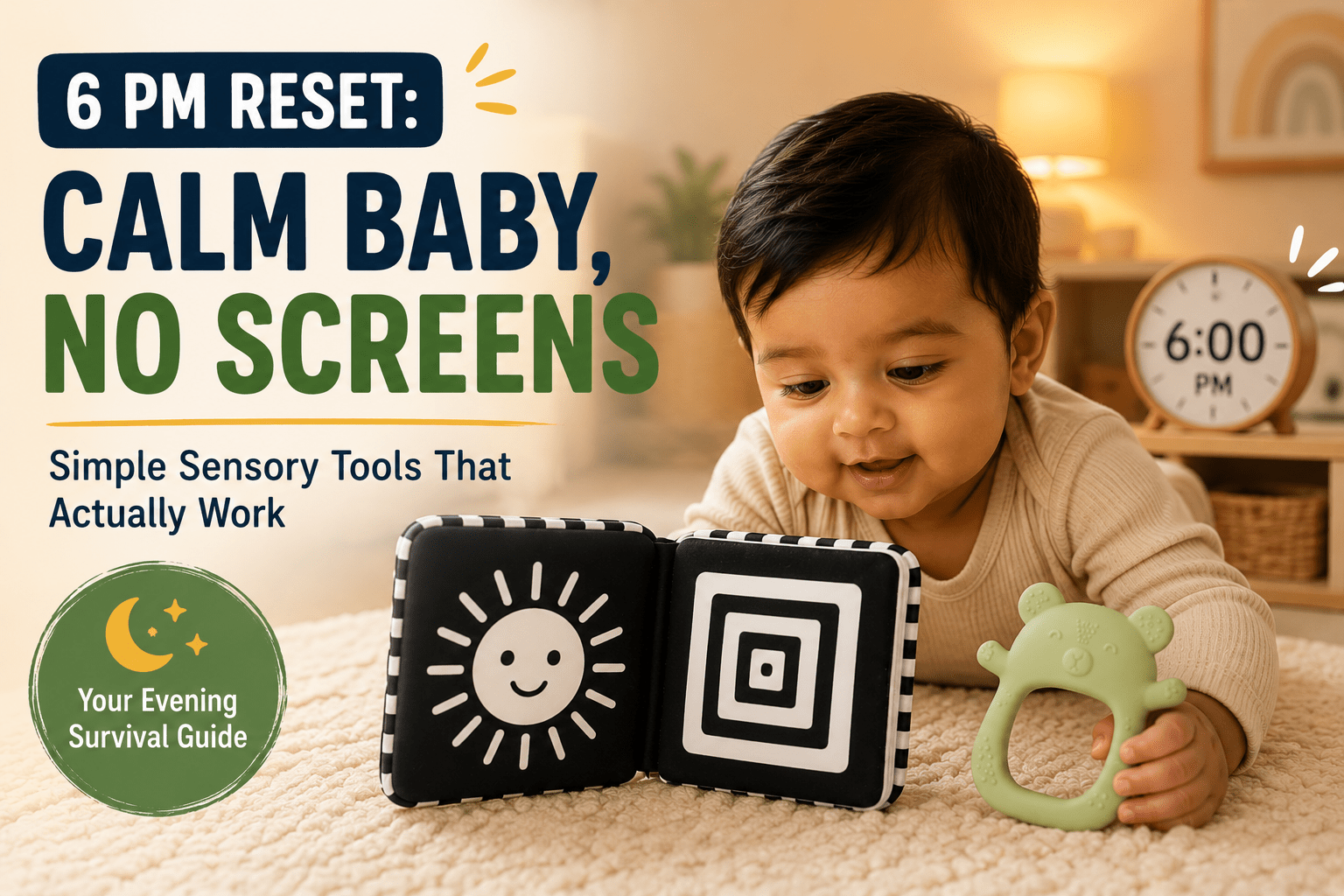
- Use a consistent object or sensory cue—a particular blanket, a soft toy (like a cloth book from Nubokind's High Contrast collection), or a lullaby that signals sleep is coming
- Protect the sleep window even if the routine location changes—respect nap time as a low-stimulation period, even if it's in a shared room
- Communicate realistic expectations to family—"4-month-old needs a nap from 1–2 p.m." is easier to honor than "she should sleep longer"
What this means for your baby: Flexibility is a feature, not a flaw. Your baby doesn't need a silent, dark room to develop healthy sleep—they need predictability and a caregiver who understands their wake windows. Maa-baap ka pyaar matters more than perfect conditions.
WHAT THE RESEARCH SAYS ABOUT INFANT SLEEP AND DEVELOPMENT
Research published in developmental journals consistently shows that:
- Sleep consolidation follows brain maturation, not willpower. You cannot teach a 6-week-old to sleep through the night because the neural systems supporting long sleep stretches aren't developed yet.
- Sensory input during wake time improves sleep quality. Babies who experience varied textures, sounds, and gentle proprioceptive input (pressure, movement) during the day show better sleep organization at night. This is why tummy time, baby massage, and age-appropriate sensory play matter.
- Parental stress directly affects infant sleep. Babies detect parental anxiety through touch, tone, and body language. A calm, confident caregiver helps regulate a baby's nervous system more effectively than any technique.
- Responsive care and sleep organization aren't opposites. Responding to your baby's needs and gently building sleep habits can happen together—they're not competing goals.
What this means for your baby: Trust your instincts and your baby's neurodevelopment. You don't need to choose between being responsive and supporting good sleep. Both are happening at once.
PRACTICAL TOOLS TO SUPPORT SLEEP DEVELOPMENT
Beyond routine, sensory tools can support your baby's sleep readiness and nervous system regulation. Teething toys, for example, aren't just for teething—they provide oral motor stimulation that calms the nervous system. During the 4–6 month period, when babies begin to discover their hands and mouth, a safe silicone ring teether gives them appropriate sensory input and can become part of the pre-sleep comfort routine.
Similarly, high-contrast cloth books provide safe visual and tactile stimulation during awake time, supporting neural development and keeping your baby engaged in a way that doesn't overstimulate. When you rotate toys and activities throughout the day, you're naturally preventing overstimulation while building the kind of developmental support that leads to better sleep organization.

The Kiko No-Drop Newborn Teether is designed specifically for younger babies (from birth), offering oral stimulation and proprioceptive feedback that supports calming. Many parents find that 10–15 minutes of gentle teether play before the bedtime routine helps transition babies from active play into a calmer state.
What this means for your baby: The right tools aren't distractions—they're developmental supports that fit naturally into a routine and help your baby's nervous system regulate itself.
FREQUENTLY ASKED QUESTIONS
Q: My 3-month-old wakes every 45 minutes. Is this normal, or should I sleep train?
A: This is completely normal. A 3-month-old's sleep cycle is still 50–60 minutes long, so 45-minute wake-ups reflect their neurological stage, not a sleep problem. Their circadian rhythm is just beginning to organize. Sleep training at this age isn't appropriate because their brain isn't developmentally ready to consolidate long sleep stretches. Focus on understanding and respecting wake windows instead. Most babies naturally show longer sleep stretches around 4–6 months as their sleep cycles lengthen.
Q: How do I fit a bedtime routine into our joint family home with multiple caregivers?
A: Consistency in routine *order* matters more than consistency in location or exact timing. Even if naps happen in the living room and bedtime happens in a shared bedroom, the sequence—maalish, bath or wash, quiet activity, feed—stays the same. Brief everyone on the routine and why sleep windows matter. Babies adapt to varied environments when the caregivers are aligned. Choose one person (usually the primary caregiver) to lead the bedtime routine when possible, but flexibility is realistic and fine.
Q: When can I expect my baby to "sleep through the night"?
A: This depends entirely on your baby's development, not their age. Longer sleep stretches typically become *possible* around 4–6 months when sleep cycles lengthen and deep sleep increases. However, many perfectly healthy 6-month-olds still need night feeds. By 9–12 months, most babies are neurologically capable of sleeping 6–8 hours straight if their hunger and comfort needs are met. Expect variability—teething, illness, developmental leaps, and growth spurts all disrupt sleep temporarily.
Q: Is it okay to let my baby sleep during the day even if it disrupts bedtime?
A: Short answer: respect wake windows over clock time. If your 3-month-old has been awake for 60 minutes, they need sleep, even if it's 5 p.m. A well-napped baby actually sleeps *better* at night because they're not overtired. The paradox is real—skip naps to "force" earlier bedtime and you'll get hyperarouse, fractured sleep. If daytime sleep is pushing bedtime too late, gradually shift wake-up times earlier rather than cutting naps.
Q: What's the difference between a newborn teether and a regular toy for sleep support?
A: A teether is specifically designed for oral motor development and safe chewing. It provides proprioceptive input (pressure feedback) that calms the nervous system and can become a helpful sensory tool in a bedtime routine. A regular toy might be visually stimulating but won't have the same calming, oral-motor benefit. For babies 4+ months, incorporating a teether into the pre-sleep wind-down can signal relaxation to the nervous system.
Q: Should I keep my baby awake longer to make them more tired for better sleep?
A: No—this is one of the biggest sleep myths. Keeping a baby awake past their wake window creates hyperarousal (an overstimulated nervous system state) that makes sleep *harder*, not easier. You'll see more frequent night wakings, more restlessness, and more difficulty falling asleep. Respecting wake windows—putting your baby down *before* they're overtired—actually leads to longer, sounder sleep stretches. Trust the neuroscience, not the old saying.
CONCLUSION
Your baby's sleep isn't a puzzle to solve—it's a neurological process unfolding on its own timeline. Understanding the science behind infant sleep cycles, circadian rhythm development, and wake windows transforms midnight frustration into informed patience.
The key insights to carry forward: Your newborn's frequent wake-ups reflect healthy brain development. Their 50-minute sleep cycle is normal until around 4 months. Wake windows matter more than clock time. Consistent routines signal to their developing brain that sleep is coming. Traditional practices like maalish have real neurological effects. And flexibility within a consistent routine works beautifully in multi-caregiver, shared-space homes.
As you build your family's sleep routine, remember that you're not training your baby to sleep—you're supporting the natural developmental process that's already happening. Gentle, responsive, consistent care is all your baby's brain needs to organize itself.
For more tools to support your baby's sensory development and nervous system regulation, explore Nubokind's collection of developmental toys and tools, designed with Montessori principles and your baby's neurodevelopment in mind.


leave a comment
This site is protected by hCaptcha and the hCaptcha Privacy Policy and Terms of Service apply.