
High Contrast Flashcards for Babies: 7 Reasons They Accelerate Brain Development
The Parent's Quick Answer:
Newborns are born with an underdeveloped visual system, viewing the world in a "blurry fog". High-contrast black-and-white patterns provide the sharpest possible signal to their brain, "switching on" the visual cortex to create up to 1 million neural connections every second.

1. Organizing the "Magnocellular" Pathway
Recent studies, including research from MIT, suggest that the "blurry" vision newborns have is actually a biological tool that helps the brain focus on light intensity and movement before it is overwhelmed by color. High-contrast visuals stimulate the magnocellular pathway — the neural circuit responsible for detecting object shapes and edges — allowing the brain to organize its visual hardware correctly from day one.
2. Boosting Focus and Attention Spans
While babies are famous for short attention spans, high-contrast images have a unique "magnetic" effect. Because their eyes can clearly distinguish these bold edges, they will often stare at a black-and-white book for many seconds or even minutes. This "staying power" is the earliest form of concentration training, helping your baby build the mental stamina needed for future learning.
3. Training "Bilateral" Coordination
Newborn eyes don't always work as a team; you might even notice them "wandering" or appearing slightly crossed. High-contrast targets provide a clear, "grippable" visual for both eyes to latch onto simultaneously. This helps the eyes learn to coordinate, a process called binocular vision, which typically stabilizes by the third month.
4. Enhancing Tummy Time Motivation
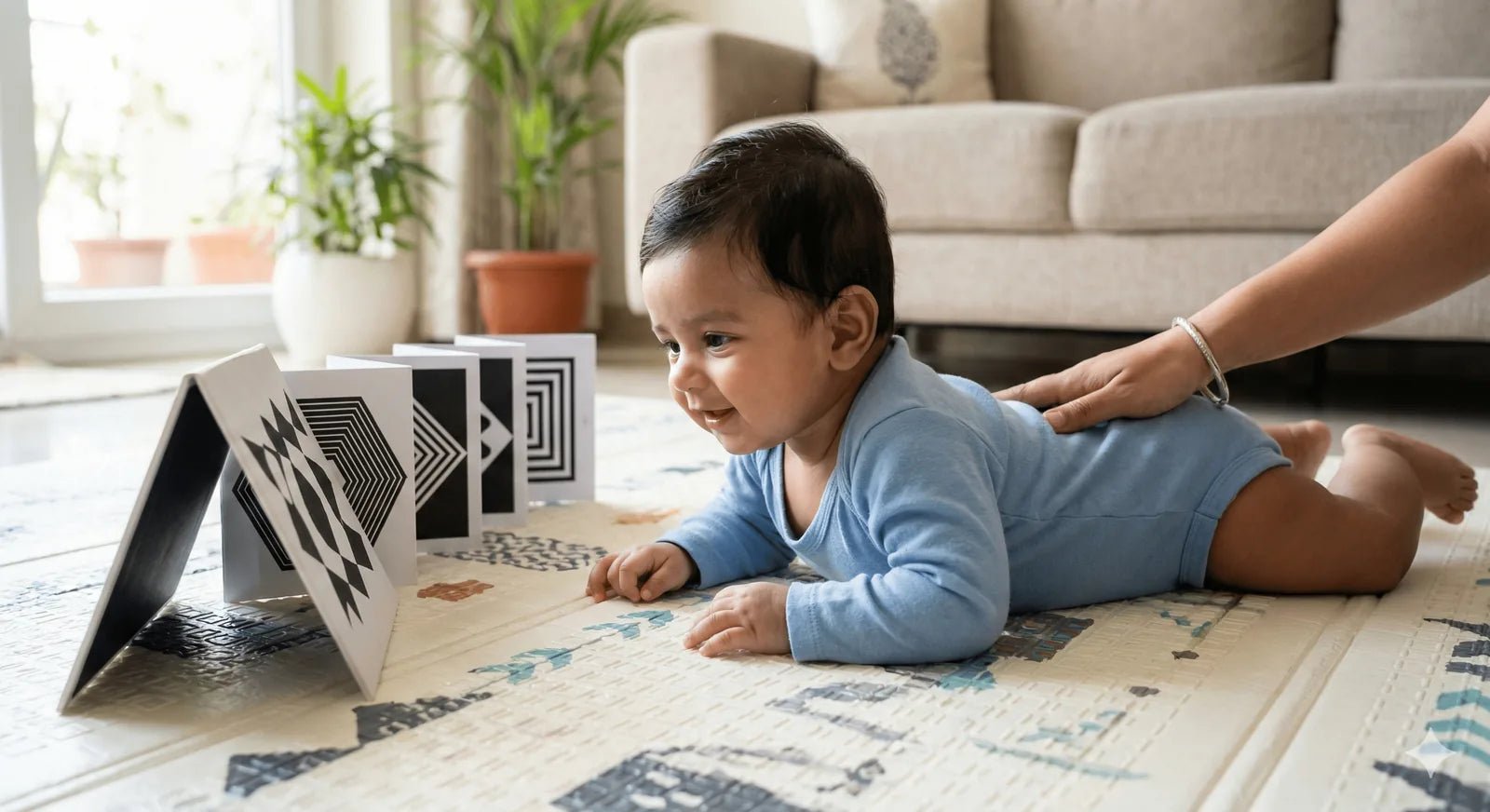
Tummy time is crucial for building neck and core strength, but many babies find it frustrating. Propping a high-contrast book about 8–12 inches away (the distance they can see most clearly) provides a visual "reward". This motivates them to lift their heads and engage their muscles, turning a difficult chore into a game of discovery.
5. Developing Eye-Tracking for Later Reading
Visual tracking is the ability to follow a moving object with the eyes. By slowly moving a high-contrast card horizontally in front of your baby, you help them practice this critical skill. This eye movement control is a prerequisite for hand-eye coordination and, eventually, the ability to track lines of text across a page for reading.
6. Supporting "Object Recognition" Logic
Before a baby can understand what an object is, they must recognize its boundaries. High-contrast patterns teach the brain to identify where one object ends and another begins. This "parts-to-whole" logic is the scientific foundation for problem-solving and recognizing familiar faces later on.
7. The "Goldilocks Effect" for Visual Learning
Developmental psychologists often refer to the "Goldilocks Effect" — babies prefer information that is "just right" for their current skill level. For a newborn, pastel colors are too hard to see, while complex colorful scenes can be overwhelming. High-contrast black and white is the "just right" input that provides maximum stimulation without causing stress or overstimulation.
------------------
Frequently Asked Questions: The Science of High Contrast
1. Why can't newborns see colors like adults do?
At birth, a baby's retina — the part of the eye that detects light — is not yet fully developed. Specifically, the "cones" responsible for color vision are immature, leaving the infant to see primarily in shades of gray. Because their eyes can't yet distinguish between similar color tones, they require the sharpest possible "visual signal" (black and white) to send clear information to the brain.
2. What is the "10-inch rule" in infant vision?
Newborn vision is fixed at a short focal range of about 8 to 12 inches. Evolutionarily, this is the exact distance between a parent's face and a baby's eyes during feeding. High-contrast patterns must be placed within this specific "window" to be seen clearly; anything further away appears as a blurry, undifferentiated fog.
3. How does high contrast help "wire" the brain?
The brain grows through a process called "synaptic pruning" — it keeps the connections that are used and gets rid of those that aren't. High-contrast visuals provide intense bioelectrical stimulation to the visual cortex, signaling the brain to strengthen those specific neural pathways. This creates a robust foundation for all future visual and cognitive processing.
4. How long should I show high contrast flashcards to my newborn each day?
For newborns aged 0 to 3 months, 5 to 10 minutes per session, 2 to 3 times a day is ideal. Brief, focused sessions are more effective than long ones — newborns tire quickly, and overstimulation causes fussiness rather than learning. Rotate through 3 to 4 different patterns per session to maintain attention. By 3 months, as your baby's attention span develops, sessions can extend to 10 to 15 minutes.
5. When should I start using high contrast flashcards with my baby?
High contrast flashcards can be introduced from day one — even in the first week of life. A newborn's visual system is most receptive to high-contrast patterns immediately after birth. Begin with simple geometric patterns (stripes, checkerboards, concentric circles) held or propped at 8 to 12 inches. By 6 to 8 weeks you will notice your baby actively tracking the cards with their eyes, which is a visible sign the visual cortex is responding to the input.
About Nubokind
At Nubokind, our products are built around the science of infant visual development. The High-Contrast Newborn Essentials Kit — including 10 dual-sided flashcards and a cloth book — is designed specifically for the 0 to 6 month developmental window, providing the precise visual input newborns need during the most critical phase of neural growth. BIS certified, made from food-grade materials, and loved by 15,000+ Indian parents.

leave a comment
This site is protected by hCaptcha and the hCaptcha Privacy Policy and Terms of Service apply.