
3 Tummy Time Hacks to Build Core Strength & Focus
The Parent's Quick Answer:
Tummy time is the first essential workout for your baby’s brain and body during the critical first 24 months. Especially during newborn tummy time, it is not just about strengthening neck muscles — it is the foundational activity where visual focus connects with motor skills. This early coordination is the prerequisite for rolling, crawling, and building long-term cognitive stamina.
As experts in developmental neurology, we understand the reality: many babies struggle with infant tummy time. It is physically demanding. Their heads are heavy, neck muscles are still developing, and being face-down without engaging stimulation can quickly become frustrating.
However, skipping tummy time is not an option. Regular tummy time is essential for preventing positional plagiocephaly (flat head syndrome) and for developing the vestibular system — the sensory system responsible for balance, posture, and spatial orientation.
The solution is not forcing longer sessions, but shifting the experience from physical strain to cognitive engagement. When the brain is engaged, babies tolerate the effort longer. Below are three science-backed strategies to turn resistance into purposeful training.
Hack 1: The Visual Anchor (High-Contrast Focus)
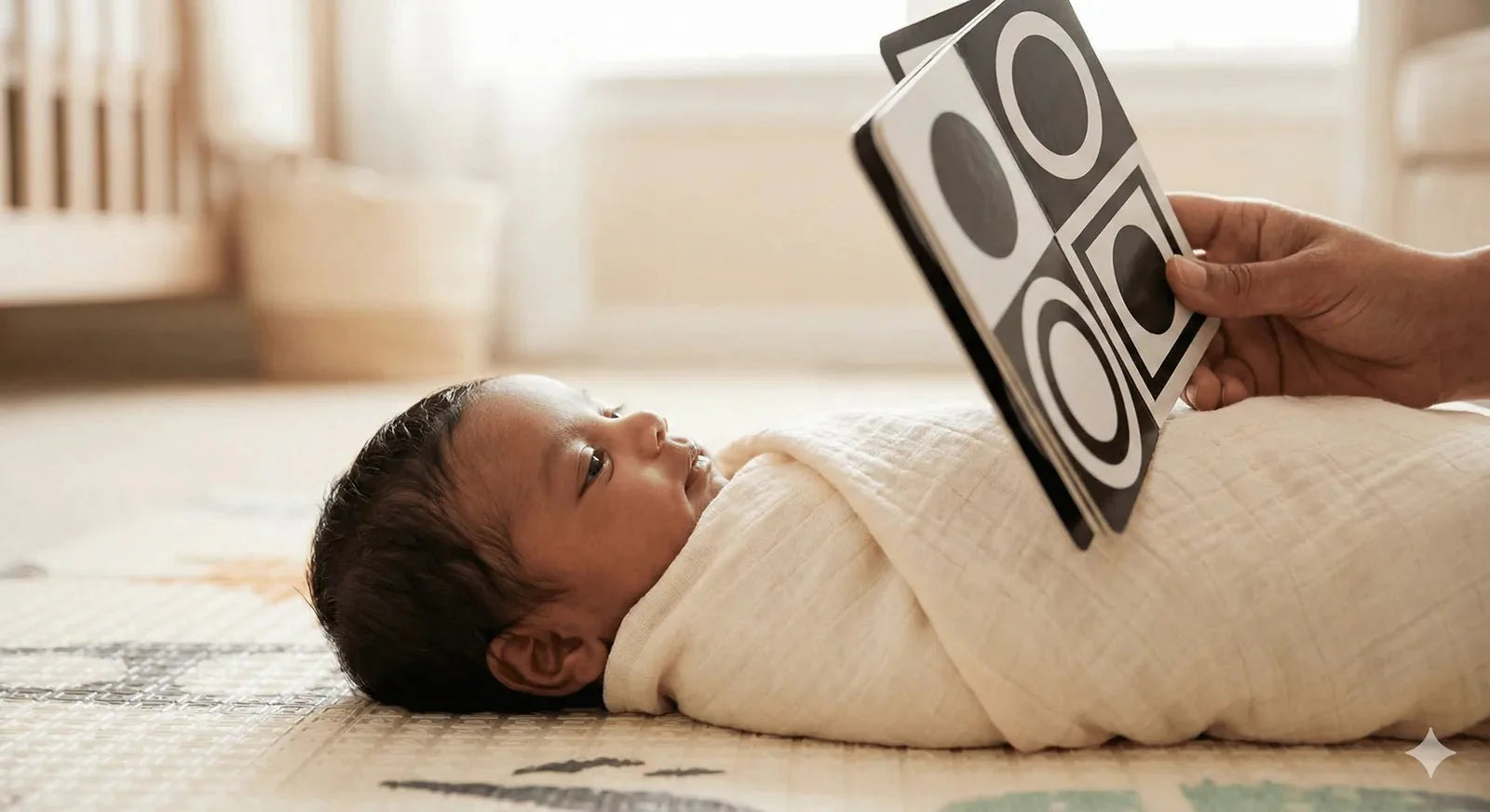
The infant brain is biologically wired to seek out high-contrast visual information. When newborns and tummy time involve nothing but low-contrast surroundings, frustration sets in quickly. Babies need a strong visual anchor.
By placing high contrast images for newborns directly at eye level, you stimulate the magnocellular pathway — the brain’s system for detecting edges, shapes, and motion. When visual attention is captured, the brain naturally signals the motor system to lift the head for a clearer view.
Developmental Insight: Tools such as a tummy time fold-out book, black and white flash cards, or a high-contrast cloth book create a stable visual “target.” This encourages prolonged head lifting and improves neck and upper-back strength during tummy time.
Hack 2: The “Prop and Pivot” (Reducing Physical Load)
For a newborn, lifting the head against gravity can feel like an intense workout. Sometimes, the physical demand alone causes resistance.
You can reduce this load by gently propping the baby’s chest. Place a firm nursing pillow, rolled towel, or rolled cotton cloth under the chest, just below the armpits, with arms positioned forward.
This slight incline makes head lifting easier, allowing babies to hold the position longer while engaging with black and white images for newborns or infant contrast cards. As strength improves over weeks 8–12, the support can be gradually reduced.
Hack 3: Mirror Motivation (Social Curiosity)
Babies are naturally drawn to faces. By around two months, social curiosity begins to develop rapidly.
Placing a shatterproof mirror in front of your baby during tummy time introduces movement, facial recognition, and curiosity. Babies will push up higher and shift their weight to interact with their reflection — strengthening the shoulders, arms, and upper back muscles needed for crawling.
Engineered for Development: A Sensory-Led Approach
Motor development does not occur in isolation — it is driven by sensory input. Thoughtfully designed tools such as sensory cloth books, black and white books for newborns, and high contrast flash cards provide the “just right” amount of stimulation to motivate physical effort.
High-contrast visuals, simple patterns, and tactile elements found in a well-designed cloth book transform tummy time from a struggle into an engaging learning experience. These tools are essential for newborn development and form a key part of early essentials for newborn routines.
Scientific FAQ: Tummy Time Realities
1. My baby cries immediately during tummy time. What should I do?
Start with micro-sessions. Even 30–60 seconds counts. Repeat 5–6 times daily, often after diaper changes. Consistency matters more than duration. The goal is familiarity, not endurance.
2. When does tummy time become less important?
Once babies can roll both ways (usually around 5–6 months) and begin sitting or crawling, structured tummy time becomes less necessary as they naturally strengthen these muscles through play.
3. Is tummy time on my chest effective?
Yes. Chest-to-chest tummy time is excellent for newborns. The incline reduces difficulty, and your face provides the ultimate high-contrast visual stimulus — often more engaging than toys.


leave a comment
This site is protected by hCaptcha and the hCaptcha Privacy Policy and Terms of Service apply.