
What is Object Permanence? 3 Games Using Peek-a-Boo Flaps
The Parent's Quick Answer: Object permanence is the cognitive milestone where a baby realizes that an object still exists even when it is hidden from sight. Usually developing between 4 and 7 months, this represents a major leap in mental mapping. It moves a baby from a “world of the moment” to a world governed by memory, prediction, and logic — skills strengthened through high-contrast visual play.
At nübo, we approach this milestone through the lens of developmental neurology. Founded by an Oxford alumna, our mission is to equip parents with science-backed tools — such as sensory cloth books and high contrast flash cards — that turn simple play into structured brain-building sessions.
The Science: Why “Out of Sight” Shouldn’t Mean “Out of Mind”
In the first few months of life, a baby’s world is made up of fleeting sensory impressions. When a toy disappears under a blanket, the infant brain initially lacks the neural architecture required to remember it. To a newborn, the object hasn’t moved — it has ceased to exist.
Developing object permanence forms the foundation for:
- Reduced Separation Anxiety: Understanding that “Mama is in the other room,” not gone.
- Memory Retention: Holding a mental image of an object in the prefrontal cortex.
- Symbolic Thought: The basis of language, where words represent objects that are not currently visible.
3 Games to Build Object Permanence Using Peek-a-Boo Flaps
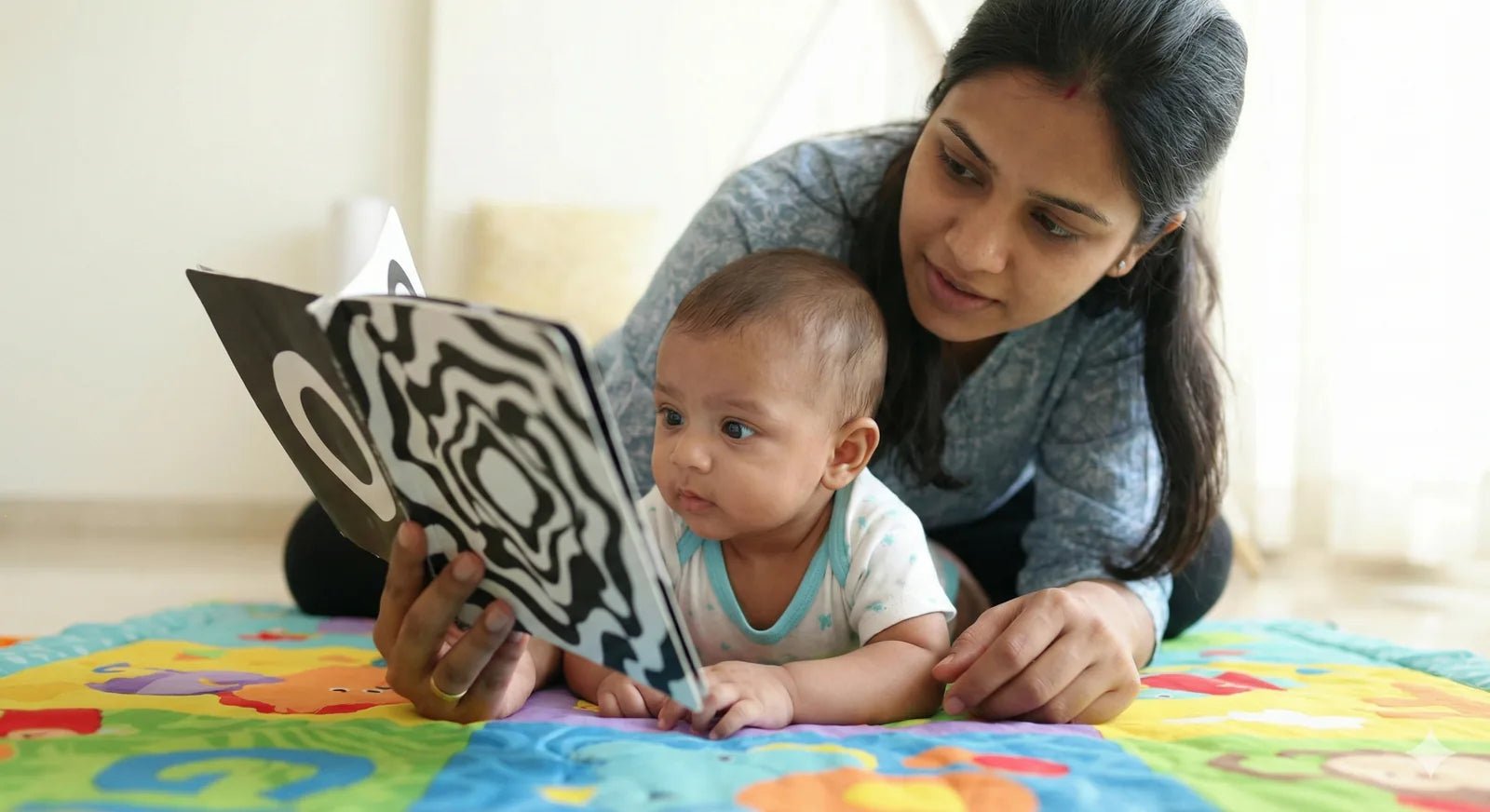
High-contrast flap books allow you to transform reading time into a series of mini scientific experiments. These activities are especially effective when paired with black and white images for newborns and infant contrast cards.
1. The “Where Did It Go?” Pause
Instead of lifting the flap immediately, tap on it and ask, “Where is the star?”
- The Logic: Creates anticipatory waiting, prompting the brain to retrieve a visual memory before confirmation.
- The Goal: Strengthening the connection between a physical location and a hidden object.
2. The Sensory Swap
Babies learn by combining senses. Scratch or tap the flap to produce a sound before opening it.
- The Logic: Builds cross-modal learning by linking sound with visual expectation.
- The Goal: Integrating auditory and visual signals to reinforce object existence.
3. The “Parts-to-Whole” Reveal
Lift the flap only halfway, revealing a small portion of the hidden shape.
- The Logic: Encourages visual completion, requiring the brain to fill in missing information.
- The Goal: Training advanced problem-solving by recognizing objects from partial data.
Ready to start the experiment? Explore the nübo My First Puzzles set, featuring high-contrast “Lift the Flap” logic puzzles designed for curious minds.
The nübo Standard: Engineered for Discovery
We don’t just make toys — we design developmental tools rooted in Montessori principles and modern neuroscience.
- Oxford-Founded Logic: Products are calibrated to match sensitive periods of brain development.
- Safety First: BPA-free materials and non-toxic inks support safe mouthing and exploration.
- Designed and Made in India: Engineered locally to meet the highest global safety standards.
Scientific FAQ
When does object permanence fully develop?
Object permanence begins emerging around 4–5 months and continues refining until about two years of age. Repeated flap-based play provides the repetition needed to strengthen these neural pathways.
Why are black-and-white flaps better for this learning?
Young infants have limited color vision. High contrast images for newborns, black and white flash cards, and high-contrast flap books deliver the clearest visual signal, allowing babies to focus on logical relationships rather than struggling to see the image.

leave a comment
This site is protected by hCaptcha and the hCaptcha Privacy Policy and Terms of Service apply.