
Most new parents spend hours choosing the perfect nursery — soft pastels, cheerful wall art, a colorful mobile spinning above the crib. It comes from a beautiful place. But here is the thing pediatricians know that most parents don't: your newborn cannot see any of it. Not really.
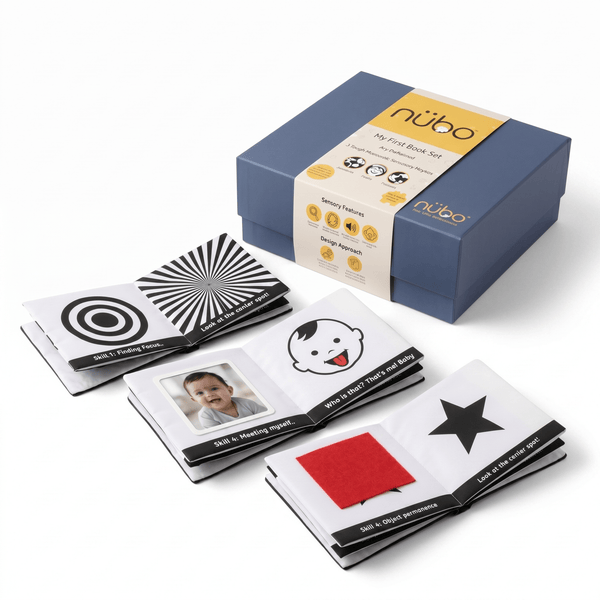
This post explains exactly what infant visual development looks like in the first three months, why high contrast images for infants matter so much during this window, and how you can use them practically during feeds, tummy time, and those short awake windows — without adding one more complicated thing to your day.
Quick Answer
Newborns can only see clearly at 20–30 cm and respond best to black-and-white high contrast images from day 1. Color vision starts around 4–8 weeks and develops fully by 3–4 months — so high contrast is the right tool for the first 8–12 weeks specifically.
How Newborn Vision Works in the First 3 Months
Newborn vision is significantly limited at birth, with visual acuity around 20/400 — roughly equivalent to legal blindness by adult standards. Their optimal focal range is just 20–30 cm, which happens to be almost exactly the distance between a baby and a caregiver's face during feeding.
Here is what is happening underneath that blur. A newborn's retina contains two types of photoreceptors: rods, which detect light and contrast, and cones, which process color. At birth, the cone cells are underdeveloped and the neural pathways connecting the eyes to the visual cortex are still undergoing myelination — the process by which nerve fibers develop their insulating sheath to carry signals efficiently.
Because of this, the newborn visual system responds most strongly to high contrast stimuli. Black-and-white patterns and bold edges send the clearest, strongest signals to the visual cortex. Every time a newborn focuses on a high contrast image, they are literally building the neural architecture their visual system will rely on for the rest of their life.
Color vision, by contrast, requires cone cell maturity that simply isn't there yet. Most newborns cannot process color meaningfully for the first four to eight weeks. This is not a deficit — it is the expected developmental sequence, confirmed by decades of vision research and aligned with guidance from the Indian Academy of Pediatrics (IAP) on screen-free sensory stimulation from birth.
What Are High Contrast Images and Why Do Newborns Need Them?
High contrast images for babies are visuals that feature maximum difference between light and dark areas — typically black-and-white patterns, bold geometric shapes, strong outlines, or simple repeating designs. The contrast ratio between elements is as high as possible, giving the underdeveloped visual system the clearest possible signal to work with.
Why do newborns need them specifically? Because high contrast patterns stimulate retinal ganglion cells — the specialized neurons in the eye that detect edges and movement — more effectively than any other visual input at this stage. That stimulation travels up the optic nerve and activates the visual cortex, encouraging synapse formation and accelerating the development of neural pathways that will later support tracking, depth perception, and color vision.
Put simply: looking at high contrast images is not entertainment for a newborn. It is exercise for a developing brain. The IAP recommends avoiding screens entirely in the first two years and instead encouraging screen-free sensory experiences from birth — high contrast visual stimulation is one of the cleanest ways to do exactly that.
High Contrast Books vs. Flashcards vs. Wall Posters — What Works Best?
High contrast books are the strongest option for this age group. They can be held at exactly the right focal distance, moved gently to encourage visual tracking, and handed to the baby for mouthing and tactile exploration once they develop grasp — all of which adds multi-sensory richness to a single object. During feeds or tummy time, a parent can prop a cloth book open and get a focused visual session without any extra setup.
Flashcards work well for deliberate, structured sessions. They are easy to cycle through and allow you to vary the image quickly. The Nubokind High-Contrast Flashcards and Tummy Time Banner — 10 double-sided cards plus a self-standing banner your baby can focus on during tummy time — is the most practical flashcard format for Indian parents.
Wall posters provide passive stimulation when the baby happens to look in the right direction. There is nothing wrong with having them up, but do not rely on them as your primary visual stimulation tool — there is no control over focal distance, and the interaction is entirely one-sided.
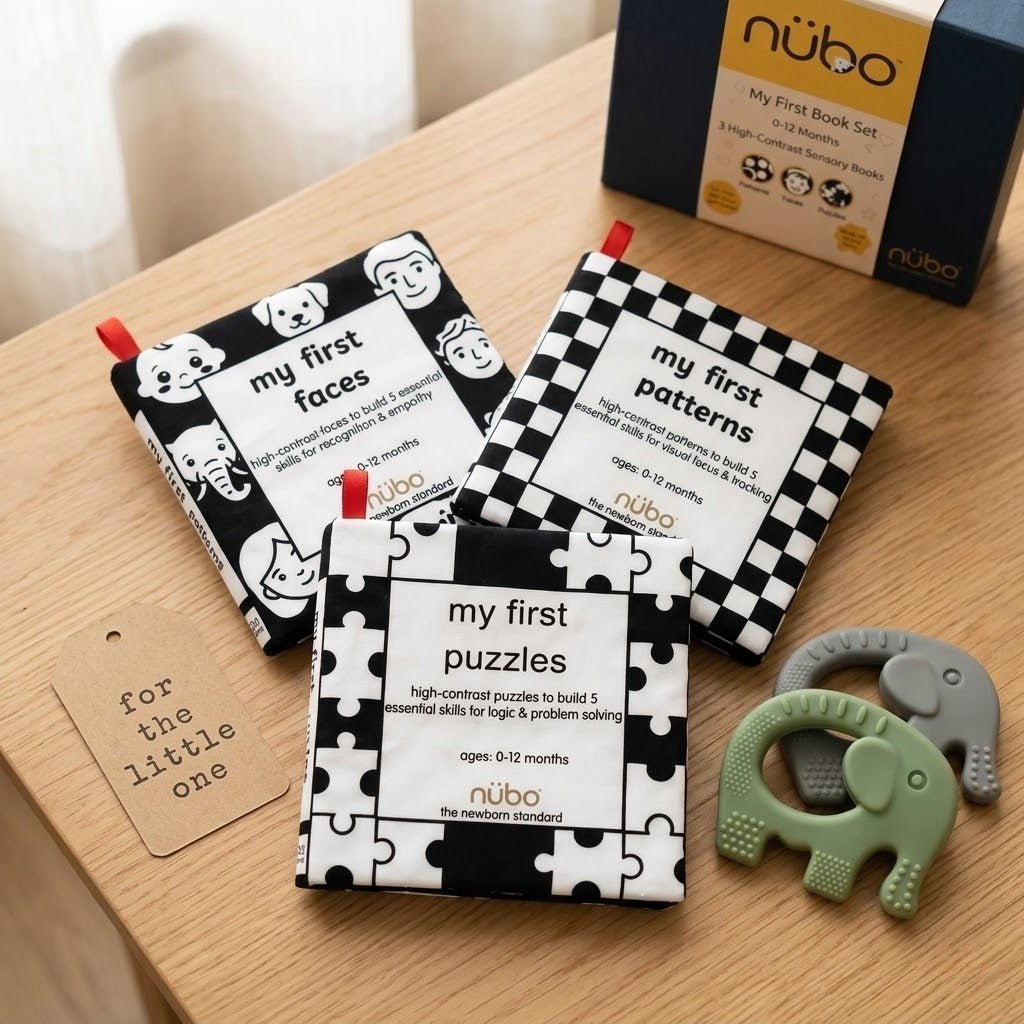
For the 0–3 month window, black and white books for newborns are the most practical, developmentally appropriate choice. The Nubokind My First Book Set is designed specifically for this developmental window — high contrast pages for the newborn phase that transition naturally to bold color as visual maturity increases. All three formats sit together in our high contrast newborn essentials range if you want to compare them side by side.
When Can Babies Start Seeing Color? (Clear Timeline)
Understanding the color vision timeline helps you choose the right visual stimulation at each stage — and know exactly when to shift gears.
| Age | What They See |
|---|---|
| 0–4 weeks | Mostly light and dark; high contrast only |
| 4–8 weeks | First hints of red and green begin to emerge |
| 2–3 months | Basic color distinctions appear |
| 3–4 months | Full color vision developing rapidly |
| 4–6 months | Strong preference for bright, saturated colors |
Pro Tip: The 3–4 month mark is your natural transition point. This is when to start introducing colorful books alongside your high contrast ones — not replacing them, but layering them in. Your baby's visual cortex is now ready to process the additional complexity.
How to Use High Contrast Images in Your Daily Routine
You do not need a structured "visual stimulation schedule." You need three or four natural daily moments where you fold this in without thinking about it.
During feeds. Hold a high contrast book or flashcard about 25 cm from your baby's face — roughly the width of a standard A4 sheet held sideways. Let them look while they feed. You will notice their gaze locking on and then drifting away; that gaze aversion is their way of saying they need a break.
During tummy time. Place an open cloth book flat on the mat directly in front of your baby's face. It gives them a visual target to lift their head toward, which means tummy time becomes both a motor and sensory workout simultaneously.
During awake windows. In those 20–40 minute alert windows between feeds and sleep, prop a high contrast book against a pillow or rolled blanket at the right distance. Sit with your baby and describe what you see — your voice adds an auditory layer that compounds the developmental benefit.
Session length. Keep it to 5–10 minutes at a time. Watch for signs that your baby is done: gaze aversion, turning the head away, fussing, or becoming glassy-eyed. Overstimulation is real in newborns, and respecting their cues builds trust as much as it protects their developing nervous system.
Frequently Asked Questions
What are high contrast images for newborns?
High contrast images are visuals with strong black-and-white or bold-color patterns and maximum difference between light and dark areas. Because newborns have underdeveloped color vision and poor visual acuity at birth, these high contrast patterns are the clearest signals their visual system can process — making them the most effective form of visual stimulation in the first 8–12 weeks.
When should I start showing high contrast images to my baby?
You can start from day one. There is no minimum age requirement — newborns respond to high contrast stimuli immediately after birth. Keep sessions short (5 minutes is plenty in the first two weeks) and watch your baby's cues to know when they have had enough.
Are the Nubokind cloth books suitable for newborns from day one?
Yes. The Nubokind My First Book Set is designed for babies from 0 months, with high contrast black-and-white pages sized and patterned specifically for the newborn focal range. The pages also transition to bolder colors as visual maturity develops, so the same book set grows with your baby through the first 6 months.
Your baby's visual system does most of its foundational wiring in these first three months — and it does not need a screen, a toy subscription, or an elaborate setup to develop well. It needs faces, voices, and the right kind of visual input at the right distance.
If you want to give your newborn a strong sensory start, the Nubokind My First Book Set and the High-Contrast Newborn Essentials Kit are designed with exactly this developmental window in mind — BIS certified, made in India, and built to be used, mouthed, and loved. Start with five minutes during your next feed. That is genuinely all it takes.

leave a comment
This site is protected by hCaptcha and the hCaptcha Privacy Policy and Terms of Service apply.