
Are Cloth Books Good for Babies? Brain Development in the First 6 Months
The short answer
Yes, cloth books are good for babies. They engage sight, touch and hearing at the same time, which is the kind of multi-sensory input a newborn's brain learns from fastest. High-contrast pages support visual development, varied textures build sensory processing, and crinkle sounds teach cause and effect. They are safe from birth and recommended as screen-free play by the Indian Academy of Pediatrics.
Infant cloth books are one of the most powerful and underrated tools for supporting your baby’s brain development in the first six months, with no screens, no gadgets, and no elaborate setup required. More neural connections form in this window than at any other point in human development, and what your baby sees, touches, and hears directly shapes how those connections get wired.
Here is what most parents do not realise: a simple infant cloth book, held 8–12 inches from your baby’s face during tummy time or a quiet evening feed, can do more for their growing brain than almost anything else at this age.
This post explains exactly why, with the science to back it up.
What Is Happening Inside Your Baby's Brain in the First 6 Months
At birth, your baby's brain is about 25% of its adult size. By the end of the first year, it will reach roughly 75%. That growth is not random, it is driven by sensory input.
Every time your baby sees a high-contrast pattern, feels a crinkly texture, or hears a soft rustle, neurons in their brain fire and form synaptic connections. The more frequently a connection is activated, the stronger it becomes. This process is sometimes called "serve and return": your baby takes in a stimulus, their brain responds, and the loop strengthens.
Pediatric neuroscientists describe the first six months as a "sensitive period", a window where the brain is uniquely receptive to certain kinds of input. Visual stimulation, tactile exploration, and auditory cues all play distinct roles in developing specific regions of the brain.
The Indian Academy of Pediatrics (IAP) recommends screen-free, sensory-rich play from birth, and cloth books are one of the most natural, low-stimulation ways to provide exactly that.
How Cloth Books Stimulate Multiple Senses at Once
What makes a cloth book different from a plastic toy or a picture on a wall is that it engages several senses simultaneously.
1. Sight: Visual Cortex Activation
Newborns are born with limited vision. At birth, babies can only focus clearly on objects 8–12 inches away, roughly the distance between a parent's face and their eyes during a feed. Their visual cortex, the part of the brain that processes what they see, is still developing.
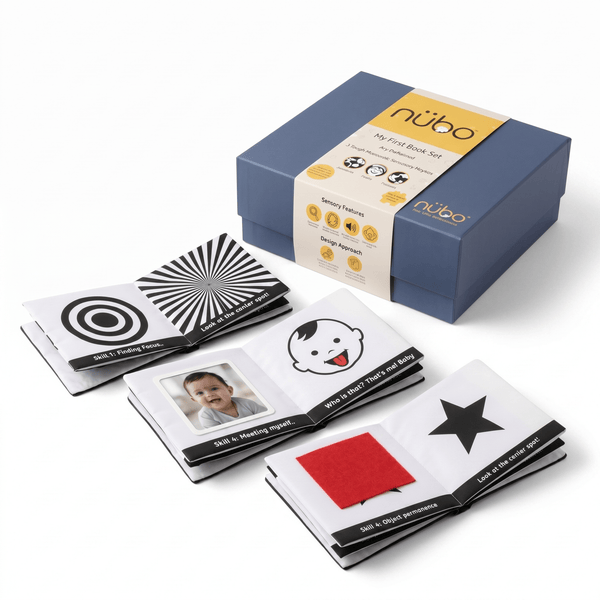
High-contrast images, meaning bold black-and-white patterns, sharp edges and simple geometric shapes, are the clearest visual signal your newborn's brain can actually process. When your baby stares at a high-contrast page, their visual cortex is actively building the pathways that will eventually allow them to see the world in full colour and detail.
Early, consistent visual stimulation in the first three months has been linked to faster visual acuity development and stronger attention spans later in childhood.
2. Touch: Sensory Processing and Fine Motor Foundations
Cloth books are soft, foldable, squishable, and often have textured pages: satin, crinkle fabric, cotton loops. When your baby grabs, mouths, or pats the pages, they are activating the somatosensory cortex, the part of the brain that maps and interprets touch.
At 3–4 months, babies begin reaching intentionally. At 4–6 months, they start grasping objects with purpose. A cloth book with varied textures is one of the best tools for encouraging this natural progression. Each new texture tells the brain something different, smooth versus rough, soft versus stiff, and those distinctions build the sensory vocabulary that underpins fine motor development.
Mouthing is also completely normal and developmentally expected from around 4 months onward. This is why the materials in a cloth book matter: they need to be non-toxic, dye-safe, and washable. Always choose books made from materials that are safe for contact with a baby's mouth and skin.
3. Sound: Auditory Engagement and Cause-and-Effect Learning
Many cloth books include crinkle pages or soft rattles. When your baby swipes at a crinkly page and hears the sound, something important happens in their brain: they begin to understand cause and effect.
This is one of the earliest forms of cognitive learning. "I did something, and something happened." That loop, action and response, is the foundation of problem-solving, curiosity, and eventually, language.
The Screen-Free Advantage (and Why Indian Paediatricians Support It)
Indian parents are under enormous pressure, from social media, from relatives, and from well-meaning neighbours, to try every new gadget that promises to make their baby "smarter." Tablets. Baby YouTube. LED light-up toys.
The IAP is clear: screens are not recommended for children under 2 years of age. This is not because screens are harmful in isolation, but because passive screen time does not engage the senses the way real-world interaction does. A baby watching a screen is not touching, smelling, or actively responding, they are simply receiving.
A cloth book, by contrast, requires your baby to be an active participant. They reach, grab, look, listen, and explore at their own pace. And crucially, when you sit with your baby and narrate what you see on the page, "Look, this is a circle. Can you feel this bumpy patch?", you are adding the richest stimulus of all: your voice, your face, and your language.
That combination, physical object plus caregiver interaction, is what the research consistently identifies as the most powerful driver of early brain development.
How to Use a Cloth Book in the First 6 Months
You do not need a structured "session." Just weave it into what you are already doing.
0–2 months: Hold the book 8–12 inches from your baby's face during alert, wakeful moments. Let them stare at high-contrast pages. Describe what you see in a calm voice.
2–4 months: Lay the book flat during tummy time. Your baby will look at it, and eventually try to swipe at it. This builds neck strength, visual tracking, and reaching skills all at once.
4–6 months: Let your baby hold the book themselves. They will bend it, mouth it, crinkle it, and eventually "turn" pages with your help. This is fine, it is exactly what the book is for.
The joint family setting that many Indian families live in actually works in your baby's favour here. Different caregivers, Nani, Dadi, an older sibling, can all spend a few minutes with the book. Each voice and each face is a new form of stimulation.
What to Look for in a Cloth Book for an Indian Newborn
Not all cloth books are equal. Here is what to check before you buy:
- High-contrast pages for the 0–3 month stage (black, white, bold patterns)
- Varied textures, at least 2–3 different fabric types
- Crinkle or sound element for auditory engagement
- Non-toxic, washable fabric, because babies will mouth it
- Safe dyes and colourfastness, colour should not bleed when wet
- BIS certification or equivalent safety standard, especially important for any product in close contact with your baby
The Infant Cloth Book Set from Nubokind is designed with these milestones in mind: high-contrast pages for newborns, transitioning to colour-rich spreads as your baby grows, with crinkle elements and varied textures throughout.
If you are starting from birth, the High-Contrast Newborn Essentials Kit pairs the cloth book with other sensory-first tools designed specifically for the 0–3 month window.
The Bottom Line
The first six months are not a time to rush your baby. They are a time to meet them exactly where they are, and where they are is a world of shapes, textures, and sounds that are just beginning to make sense.
A cloth book is not a "baby toy." It is a developmental tool designed to work with your baby's biology, not against it. Used consistently, it supports visual cortex development, sensory processing, fine motor foundations, and the earliest seeds of cognitive learning, all without a screen in sight.
Frequently Asked Questions
Are cloth books good for babies?
Yes. Cloth books are good for babies because they engage sight, touch and hearing at the same time, which is the kind of input a developing brain responds to most strongly. High-contrast pages activate the visual cortex, varied textures build sensory processing and fine motor foundations, and crinkle sounds teach cause and effect. They are soft, washable and safe to mouth, so they can be used from birth, and they are screen-free, which the Indian Academy of Pediatrics recommends for children under two.
Do cloth books really help with brain development?
Yes. Cloth books engage multiple senses simultaneously, sight, touch, and hearing, which stimulates neural connections in the visual cortex, somatosensory cortex, and auditory centres of the brain. The combination of high-contrast visuals, varied textures, and crinkle sounds makes them one of the most developmentally rich tools for babies under 6 months.
At what age should I start using a cloth book with my baby?
You can introduce a high-contrast cloth book from birth. Newborns are awake and alert in short windows, and holding a high-contrast page 8–12 inches from their face during those moments actively engages their developing visual cortex. Most babies begin reaching for and grasping the book around 3–4 months.
Are cloth books safe for babies to chew?
Yes, provided the book is made from non-toxic, dye-safe fabric and is washable. Mouthing is normal and expected from around 4 months, so the material matters more than the design. Look for BIS certification or an equivalent safety standard on any product that will spend time in your baby's mouth.
Which cloth book is best for newborns in India?
Look for a cloth book that starts with high-contrast visuals and transitions to colour as the baby grows, with varied textures and safe materials. The Nubokind Infant Cloth Book Set is designed specifically for the Indian market with developmental milestones in mind.


leave a comment
This site is protected by hCaptcha and the hCaptcha Privacy Policy and Terms of Service apply.