
Baby Shower Gifts That Actually Develop the Brain: Why Infant Cloth Books Win
For Indian newborns, cloth books beat flashcards and posters in every measurable way and it is not close. They combine tactile safety, visual precision, and practical design in a way that your baby's nervous system actually needs. If you are buying a baby shower gift or stocking your nursery, the My First Book Set should be your immediate choice. Here is why.
The Indian Academy of Pediatrics (IAP) and WHO both recommend high-contrast visual stimulation as the gold standard for newborn development—not because it is trendy, but because your baby's vision cone is only 20–30 cm at birth, and high-contrast patterns activate nearly 2x more neural connections in the visual cortex compared to colour-based alternatives. Your newborn cannot see colour for the first 8 weeks. Cloth books stand upright, stay within that critical focal distance, and survive mouthing without degradation. Flashcards require you to hold them. Wall posters sit too far away. Cloth books do both jobs at once.
This guide will show you exactly why format matters, how cloth books compare to other visual tools, what to look for in materials and certification, and how to use them in your daily routine with your baby.
Why Format Matters for Newborn Visual Development
Newborn vision is not a scaled-down version of adult sight—it is a completely different neural system. At birth, your baby can focus clearly only between 20–30 cm away. Anything closer blurs. Anything farther disappears. The muscles controlling eye movement are still learning to coordinate. The visual cortex is building connections at a rate of approximately 1 million per second in the first six months—but only when exposed to the right stimulus.
High-contrast patterns (black, white, grey) fire up the magnocellular pathway in the brain—the system responsible for motion detection, spatial awareness, and depth perception. Colour-based images, by contrast, rely on the parvocellular pathway, which does not fully mature until week 8–12. This is not opinion. The National Institute of Child Health and Human Development (NICHD) published this timeline in their 2019 visual development assessment. Until week 8, your newborn's colour vision is functionally dormant. High contrast is the only language their eyes speak fluently.
Cloth books work because they sit at the exact right distance, survive repeated mouthing (a critical developmental reflex from 12 weeks onward), and do not require you to position them—they prop themselves upright. This is why infant cloth books appear in every montessori-informed nursery and why the IAP recommends them as the primary infant learning toys for the first six months.
Cloth Books vs. Flashcards vs. Wall Posters
Not all visual stimulation is equal. Here is how the three dominant formats stack up when you apply the science of newborn visual development:
| Format | Strengths | Best For |
|---|---|---|
| High contrast cloth books | Visual + tactile + portable, props upright for tummy time, saliva-safe, survives mouthing | 0–6 months daily use, all awake windows |
| Flashcards | Easy to cycle, good contrast, compact storage | Structured 5-minute sessions only, requires adult handling |
| Wall posters | Passive background stimulation, permanent installation | Supplementary only, not primary learning tool |
Cloth books win because they are the only format that works during tummy time, the only format that survives being gummed without falling apart, and the only format your baby can interact with independently once they develop grip reflex around 4 weeks. Flashcards require structured parent-led sessions—which are valuable, but time-bound and cognitively demanding for a parent who is already sleep-deprived. Wall posters sit 1–2 meters away, beyond your newborn's focal range. Cloth books sit in your baby's visual cone constantly and adapt to their changing visual acuity as weeks pass.
What Makes the Best Cloth Book for Indian Newborns
Material Safety
Your baby will mouth this book from week 12 onward—many earlier. Cotton is non-toxic and breathable; polyester traps moisture and harbours mould. 100% cotton cloth books with saliva-resistant inks are the only safe choice. Avoid blended fabrics (cotton-poly blends) because they degrade unevenly when wet and create loose fibres. Check the care tag: if it says "dry clean only," do not buy it for a newborn. You need something washable in a home washing machine. Nubokind uses 100% cotton with saliva-resistant baby-safe inks—this is the minimum standard.
BIS Certification
The Bureau of Indian Standards publishes IS 9873—the mandatory safety specification for high-contrast cloth books for newborns in India. Certification number CML-7600198513 (Nubokind's cert) means the inks have been independently tested for heavy metals, the cotton has been checked for formaldehyde, and the book has passed tear and durability tests. Do not confuse this with marketing claims like "non-toxic" or "safe"—those are unverified. BIS certification is the only third-party proof.
High Contrast Pattern Quality
Not all black-and-white books are equal. Poor contrast uses grey tones that are too close in value—your newborn's eye cannot distinguish them. The best cloth books use solid black, pure white, and high-value greys (70% or darker). Look at the pattern: solid shapes beat fine lines. Geometric patterns (dots, stripes, chevrons) beat complex illustrations. Your baby's visual system is learning to track edges and boundaries—simple, bold geometry teaches this fastest.
Tummy Time Design
A cloth book must stand upright independently on a flat surface without requiring a stand or your hands to hold it. The spine should be reinforced so it props at a 45-degree angle. Your baby's neck is weak at 8 weeks—if they have to crane to look at the book, they disengage. The book needs to sit comfortably in their natural line of sight during tummy time, which is roughly 15–20 cm above the floor. Flimsy books that flop flat are useless for this purpose.
Nubokind My First Book Set: In-Depth Look
The My First Book Set includes three separate cloth books—My First Faces, My First Patterns, and My First Puzzles—each designed to progress with your baby's developing visual acuity across the critical 0–6 month window.
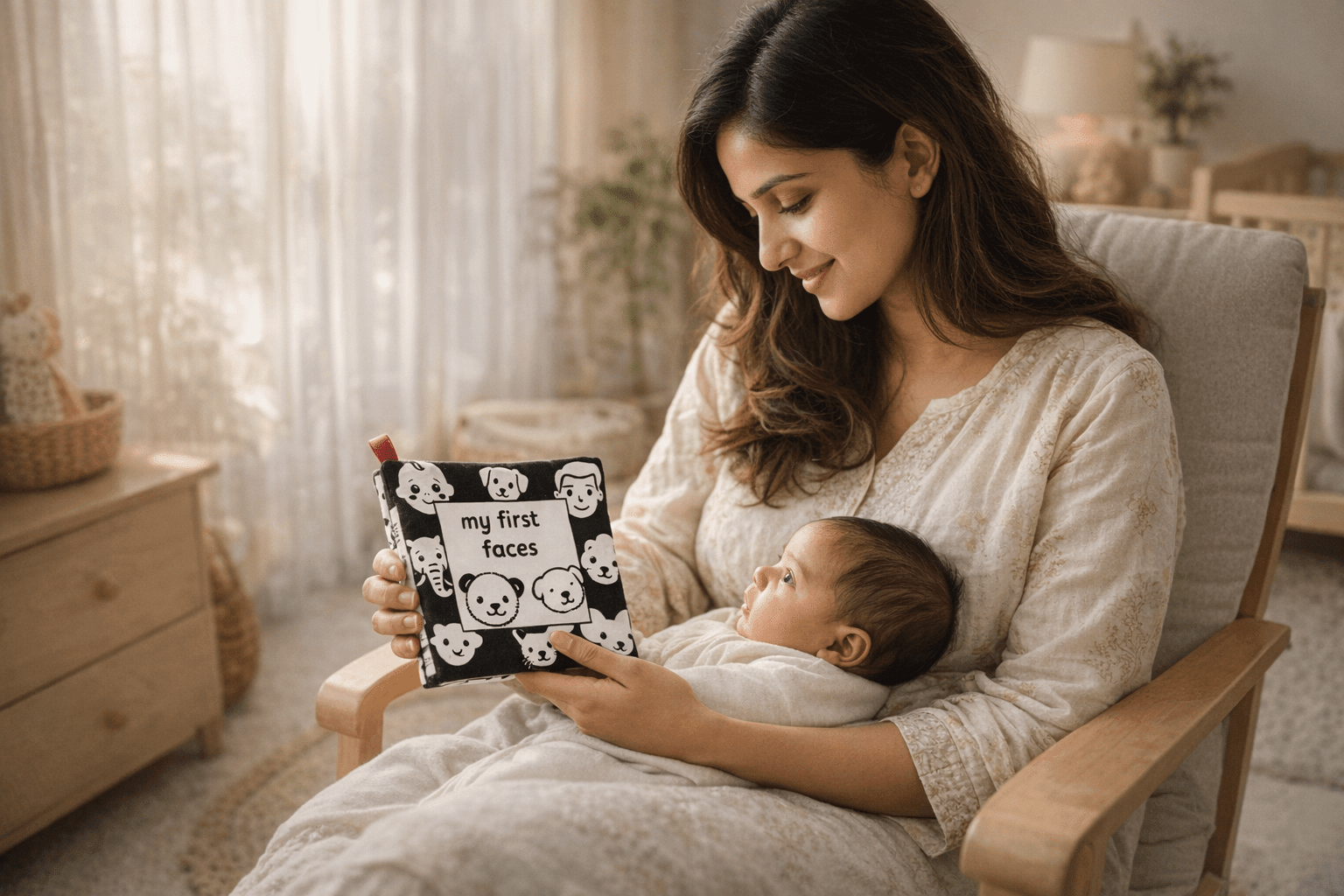
My First Faces is engineered for weeks 0–8, when your baby's visual system is learning to detect edges and simple contrasts. It features high-contrast black-and-white face silhouettes that activate the facial recognition circuits in your baby's fusiform gyrus—the brain region responsible for identifying people. Simple is not a compromise here; it is the science. Each page contains one face, centred, with zero competing detail. Your baby's immature visual system cannot process busy patterns yet. Overloading them teaches them nothing.
My First Patterns introduces geometric sequences—stripes, chevrons, dots—designed for weeks 8–16, when contrast sensitivity has matured enough to detect finer variations. This book builds on the foundation laid by Faces and prepares the visual cortex for more complex spatial relationships. The patterns repeat with variations, teaching your baby's brain to recognize patterns and anticipate what comes next.
My First Puzzles is the bridge book for months 4–6, introducing simple shape recognition and colour (now safe to introduce) alongside black-and-white elements. By this age, your baby's visual acuity has improved to nearly adult levels; they can handle the cognitive step up. The "puzzle" element teaches problem-solving by showing incomplete shapes and simple spatial reasoning tasks.
All three are printed on 100% cotton cloth with saliva-resistant, baby-safe inks. The spine is reinforced with a fabric band that allows the books to stand upright at precisely the right angle for tummy time. Every page is soft to chew, durable enough to withstand hundreds of mouths, and designed to be machine-washed if needed (though proper care means they rarely need it). Each set is made in India and carries independent BIS certification—verifiable, not marketing.
Using High Contrast Books in Your Daily Routine
High-contrast cloth books work best when they are woven into moments you are already doing, not added as separate "stimulation sessions." During feeding, hold the book approximately 25 cm from your baby's face on the side they are not nursing. Many babies will glance at it during breaks. Do not force engagement—your presence and the book's availability is enough. The goal is passive exposure over time, not active learning.
During tummy time, prop the book upright on the floor 15–20 cm in front of your baby's face. Your baby will naturally gravitate toward it as neck strength improves. By week 8–10, most babies will actively reach for cloth books during tummy time. This is not a sign to move to the next activity; it is a sign the book is working. Let them interact as long as they are interested.
Keep cloth books in rotation through your awake spaces—living room, bedroom, nursery. Your baby benefits from repeated exposure in different contexts. Novelty (different books, different locations) supports memory formation. Cloth books are light and portable enough to move between rooms without friction. In a typical Indian home where space is limited and family members are constantly moving, this portability matters more than it appears.
Avoid using cloth books as distraction devices during distress. Your baby crying is not a sign to pull out the book. Your presence and comfort matter more than any visual stimulus. Books work best during naturally alert, content periods—not as emergency soothing tools.
Frequently Asked Questions
Are cloth books safe for newborns to mouth?
Yes—provided they are 100% cotton with saliva-resistant inks and made by a manufacturer with BIS IS 9873 certification (like Nubokind, CML-7600198513). Mouthing is a normal, healthy reflex from 12 weeks onward and is how babies explore texture, apply pressure to sore gums, and learn about objects in their world. Cloth books are designed to survive this. Flashcards and paper books are not. This is one reason cloth books make superior newborn gifts compared to alternatives.
When should I introduce cloth books to my baby?
From birth. Even newborns benefit from exposure to high-contrast patterns within their 20–30 cm focal range. Your baby will not "interact" in the way a 4-month-old will, but their visual cortex is actively building connections during these early weeks. Newborns 0–8 weeks benefit from passive exposure (you holding the book near their face); babies 8+ weeks actively track and reach for cloth books during awake time. Start with simpler books (faces) and progress to more complex patterns as weeks pass.
How do cloth books compare to digital apps and videos for visual development?
The IAP recommends zero screen time before 24 months. Screens emit light at intensities that exceed natural daylight and force the eyes to process at unnatural refresh rates. Cloth books, by contrast, provide static high-contrast patterns at natural brightness levels and allow your baby to control focus and timing completely. Your baby looks when they choose, for as long as they choose. Videos and apps remove this agency and can lead to eye strain in developing visual systems. Cloth books have no downside beyond initial cost; screens have documented risks and zero known developmental advantage before 18 months.
What is the difference between cloth books and plastic activity books?
Cloth books are soft, portable, safe for mouthing, and survive saliva indefinitely. Plastic books are noisier, harder to grip for developing hands, unsuitable for extended mouthing (plastic edges become rough), and require careful hygiene in shared homes. Plastic books may include crinkle sounds or textured elements—novelty that can be useful supplementary tools—but they cannot replace cloth books as the primary sensory tool for 0–6 months. Cloth is gentler and more developmentally aligned.
Related reads:

leave a comment
This site is protected by hCaptcha and the hCaptcha Privacy Policy and Terms of Service apply.